The room was in the basement of the education building, too small for the number of desks they had forced into it. Fluorescent lights buzzed overhead. No windows. The kind of room that held heat even in winter, where the air never quite moved. Some of the desks were bolted to the floor, their plastic arms too narrow for a few of the bodies assigned to them—knees pressed into particleboard, thighs wedged, nowhere to shift without scraping. Space had already been decided before anyone sat down.
She was across from me when it happened.
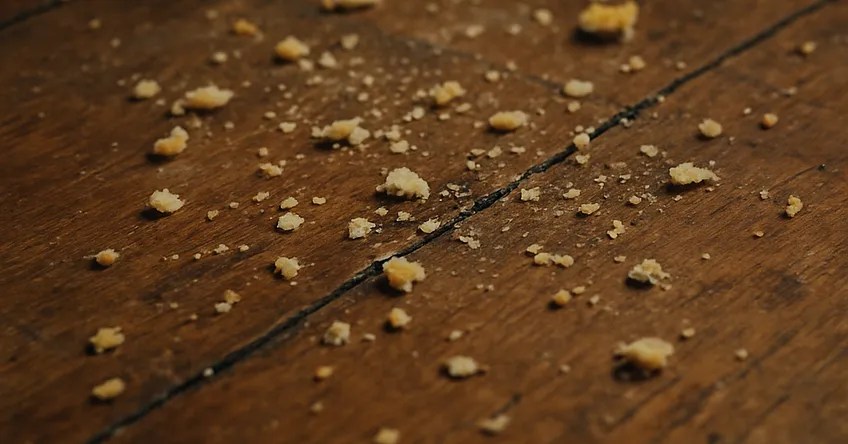
The sentence came out wrong, like something dropped mid-chew. Too many crackers or popcorn at once—dry, pale crumbs spilling ahead of intention. My dad leaving is like your dad dying. The words landed between us and stayed there. I watched them fall and felt the familiar calculation rise: I’ll have to clean these up.
I learned that reflex early. As a teenager, I worked bar shifts at a diner where the carpet never fully recovered. After closing, when the last men finally stood and left, I got down on my knees with a broom and dustpan and collected what had been pressed into the floor all night—crackers crushed to powder, fries softened by beer, sugar ground into sticky grit. One in the morning. School the next day. Homework waiting on the kitchen table. The smell of grease living in my hair. The floor never empty. The work never finished. You learn young that some messes arrive without warning and belong to you the moment they hit the ground.
Crumbs don’t stay where they fall. They migrate. They work into seams and corners. They reappear later, when you think the room has been cleared. The education always comes after everyone else has gone home.
Gillette taught me that before I had language for it. Boomtown logic. Extraction culture. Men who arrived loud and left quietly. Fathers who disappeared without ceremony. Adults whose moods shifted with the market. You learned to read tone the way you read weather—not morally, but practically. Who returned altered. Who made promises only when work was good. Who went silent when the money thinned. It wasn’t a story with a beginning and end. It was an atmosphere. A way of growing up alert, tuned to pressure changes, trained to expect disappearance without explanation.
That kind of upbringing doesn’t announce itself as trauma. It trains your nervous system. You stop asking why. You start watching behavior.
Years later, in Colorado, the lessons returned through the body. In slot canyons, for example, where the water looks calm until you step in. Cold steals your breath first, then your legs. The walls narrow until the sky becomes a ribbon overhead. Sound changes. Turning around stops being an option almost immediately. You move because not moving isn’t possible. You learn how panic wastes oxygen, how thrashing costs more than stillness, how to let the canyon set the pace instead of trying to narrate your way through it.
Colorado, in general, was an apprenticeship in duration. Not summits or views so much as mornings where your mouth was dry before you started, afternoons when the weather turned faster than forecast, evenings when you realized you had misjudged how long something would take. Early on, I packed wrong. Moved too fast. Treated fatigue like a problem to overpower. Later, I learned to carry differently. To slow down. To stop performing the experience for myself and attend to the next necessary thing.
I worked alongside people who had more than I did—houses, trucks, boats, the kind of access that turns certain experiences into weekends instead of once-only passages. They were generous. They invited me along. They were also heavy with the same sadness that lives anywhere long enough. Depression doesn’t thin at altitude. It settles just as thick. The difference wasn’t pain. It was margin. When they were tired, they went home. When something broke, there was room to fix it. When plans fell apart, there was somewhere soft enough to land. Access doesn’t erase suffering, but it changes how long it lasts and how much it costs.
Mountains don’t care about intention. Trails don’t register language. Weather doesn’t negotiate. They sort people by preparation and tolerance and luck, and they do it without commentary. Bravado gets punished. Ignorance too. Sometimes kindness does as well. You figure it out quickly because pretending costs more the longer you’re exposed.
So when certain narratives are offered as universal, they don’t always land for me. Not because harm isn’t real, but because context matters. Not all fear behaves the same in a body. Not all damage asks for language. Some of it asks for endurance. Some of it teaches you to keep moving because stopping has never been safe.
There is a version of care now that borrows the look of hard places without submitting to them. Mountains as mood boards. Rivers as backdrops. Kindness styled as identity. Language doing the work bodies once had to do. It photographs well. It promises relief without aftermath. It mistakes proximity for passage.
Wyoming is where that illusion falls apart. Dirty shops that smell like diesel and metal. Floors scarred beyond repair. People windburned and blunt, uninterested in performance. You walk in, say what you need, either get it or you don’t. Nobody sells virtue. Help looks like action—like staying, like doing the thing in front of you, like moving on without ceremony.
The Grand Canyon came later, and it came differently. There were permits and lists and gear I didn’t own. I borrowed what I could. I packed light because light was all I had. Once on the river, days lost their edges. Mornings were about loading the boat the same way every time so nothing shifted when the water did. Afternoons were about heat and shade and learning the sound of rapids before you saw them. Nights were quiet in a way that felt earned. The canyon walls held the dark.
The river did not care who we were. It carried us whether we respected it or not. Once you commit, there is no opting out—only the discipline of staying upright, of reading water correctly, of knowing when to paddle and when to let go. Weight mattered. What you brought mattered. What you carried for someone else mattered. I understood then why some people never leave and some never return. Passage changes you, but not in ways that translate cleanly.
Some experiences let you enter once, briefly, freely, without asking you to make a story out of them afterward. I don’t know if I’ll ever have that again. That feels important to record without turning it into proof.
For a long time, I thought the point was to explain all this. To translate it. To make it legible. Now I think the point is accuracy. To leave the record intact. To resist turning lived terrain into something smoother than it was.
Some people learn care as a feeling. Others learn it as a responsibility that shows up whether you’re ready or not. I know which kind I trust—the kind shaped by repetition, by constraint, by staying long enough for the shine to wear off.
Some messes get cleaned.
Some stay lodged in the floor.
Either way,
someone lives with what’s left behind.
 the misfit west