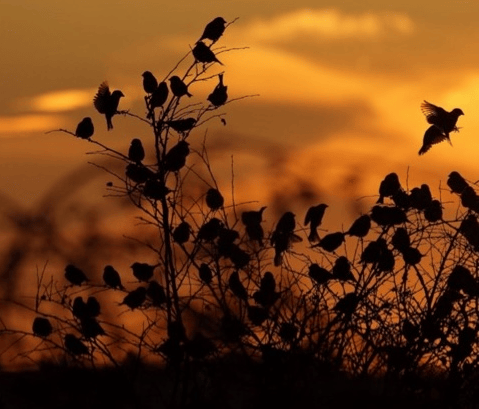
It snowed overnight. Almost five, my normal wake up time, and the yard lies white and quiet. Last night the house finches stayed at the feeder past sundown, orange chests puffed against the cold, working the nyjer like a last meal, the seed the bag calls thistle even though it isn’t, and the orange on them comes from whatever they eat. Every dusk they do it, and every dusk my mom and dad come back in with them. At church camp in Ekalaka I saved up my questions for God, where carrot seeds come from, where birds sleep, and the one that got me ostracized, whether my brother would go to heaven after stealing from my parents. The counselor asked if he had asked God into his heart. I didn’t buy it. One evening I looked over to the eaves of the bunkhouse and saw a single bird preening for sleep, fluffing his feathers, tucking his bill, lifting his leg, locking his grip.
Last night a man who works at Sweet Melissa’s came over. He found me through my sobriety post, 1212 days, a post I was real scared to put up, but what if it could help someone, ego ego ego. It reached someone. He came in sniffing my walls for lead. He circled Undine Park three times the way a dog circles before it lies down, glad I cleaned it up, glad about the other garbage can, and every lap brought him back around to his basement apartment and what it costs him. He probably makes what I make. I work two to four hours a day. This is the nicest house I have lived in that wasn’t my parents’ (never mind the dishwasher that won’t pump), I pay for every inch of it, and I’m here all the time because Angel, my three-legged husky, can’t be left alone.
I don’t do hard drugs, he told me, I would never shoot up, and he held it up like a clean plate. He is ninety-nine percent of everyone in treatment. When I went, two of us in the whole room had fetty as our drug of choice, and the room always looks like that, a few of us with tracks behind us who made it across. Meth and fetty don’t visit, they move in and put their name on the lease. I worked at Sweet Melissa’s until 2008 and left because I couldn’t stand in that much addiction anymore. He works there now. He called himself a moderate drinker, and by six his words were sliding off the table. Dude, I’m not scared of your darkness. You’re just getting it on my carpet.
I need therapy but I’m poor, he said, more than once, like a chorus, so I offered spirituality, the cheap seats, and he hissed, not literally, but you know. I told him the 95 Theses are kinda important if you are going to shit on the Catholic Church. Who else is standing up for immigrants? For the poor? Hahaha, he said, the pope has lung cancer, the American one from Chicago, the one I had just prayed for by name.
I gave him the stages of change, ambivalence, the whole map, and he planted his feet on the wrong side of every line. He wanted his liver to die, he said, and tossed it at me like a dare. He wasn’t bothering anyone, he said, from the middle of my house. You reached out to me, bro. He couldn’t trust anyone, he said, item nine on the PCL-5 almost to the word, strong negative beliefs about yourself, other people, or the world. When I got to my ecumenical meetings and what spirituality does for people in addiction, he left so fast my sentence was still hanging in the air.
Go get treatment, bro. In 2023 under eight percent of people with an alcohol use disorder got any treatment at all. Twelve hundred and twelve days, and I had them out on the table all night like a hand of cards nobody asked to see. Dad used to slip his belt out of the loop so fast I swear I saw sparks.
I thought about reaching back out, hey man, I didn’t mean to talk about God. But I did mean to. I had gone to prayer meeting for the first time and told him it was about recollecting my childhood. Somebody could have handed me help back then and I wouldn’t have known which end to hold. I for sure said at one point I don’t want to get better. Wyoming doesn’t hand out random conversations, you have to go knocking, and the only thing keeping my own damn self going is to close the laptop and knock anyway.
I wrote my father’s obituary. He was taken home by his Father on Tuesday, Dec. 9, 2008, it says, and he played the stock market with no regrets, even on the very day of his passing. He shielded me from my own personality, forever propping me up when people didn’t like me. That summer, the summer the Powder River Basin dug more coal than it ever has, I walked out of UW with an English degree and into a coal testing lab, because that’s what Wyoming had for me. Awful, tedious work. There was a sign up sheet for overtime and I signed up the way Dad would, and the other women pulled their names off my shifts one by one. We worked in pairs on swing shifts that mirrored the mines, twelve hours of somebody else’s silence.
I came home and laid it all out, and he had my back, right there in front of my mom. A small thing, and it has stuck to me ever since. We kept the same hours, and I would call over to North Antelope Rochelle, the control room, and ask for Dave, and read him the sulfur from the lab, two tenths of a percent, the cleanest coal in the country coming out of his pit, and then we’d trade jokes and hang up.
My last call to him came the night before. I said I wasn’t coming over, too cold on a night like that, and that I loved him. We joked, and that matters, because he hated the phone and always got off by saying it hurt his ear. That night a cold front came through with snow, and by the next day it was one degree above zero at the Gillette airport. He fell and froze to death. My mother found him.
At twenty-eight I wrote down his biceps like softballs, his strong arms carrying my small body down the stairs while I pretended to sleep, because I didn’t want to walk myself and I loved to be held by him. Those same arms came ripping out of the bedroom one day while I watched Flintstones in the living room, a little too loud I guess, Dad in his jeans, eyes red, no shirt, hulking, a softball shoved in his bicep, the belt in his hand. The memory of the punishment fades from there. What stays is the mystery of what I did to piss him off so bad other than watch Flintstones. He told me himself he had been an injection user, and after he died we found out about the hepatitis C, and now I wonder about the roids. They kept secrets like canned goods, and I had to pry most of them open myself, including that my brother is my half brother. But he built his own fence, panned for gold every summer in the Black Hills, and painted us, all of us, and hung us on the walls beside a painting of the welding. We had deep talks. I’m not idealizing him, we just found it easy to talk.
That last call, I had wanted to come over and see Lou dog, Louis in the obituary, one of his two loyal dogs. Later the vet took Lou’s tail, infected at my mom’s house over a snowstorm. She was a complete mess, and so was I. She hurt herself at the bar one night and it breaks my heart, and I mean breaks me, to picture her that open to the world, and then so spicy other times. I’m the same way. I feel the same pity, but it’s not pity, it’s deeper, it’s regret he died and we were never the same, and I’m sure that rode in her head at the end.
My mom killed herself.
I think of her every day. Her soft voice singing You Are My Sunshine, which is a song about waking up alone. She was the one who snuck us into things, a pasta dish with pine nuts in Broadus on the way to camp that tasted like the trees, the fanciest thing we had ever seen. I wish I remembered Dad better, but I didn’t want to get wrapped up in grief again after I got in trouble. I don’t hold either of them in contempt for anything, the hardest place to stand, because when you refuse to flatten a person the grief takes over. In grief and loss was great unaffected love, and the two cannot exist without each other.
The church is pressed into me like a thumbprint in clay, for better or worse. I know most of the verses by heart and don’t need the hymnal. When I was little they were just words in my mouth, wool tights and the long service, a God who belonged to Dad and his belt. They waited in me for thirty years. I am unbaptized but still going. As a kid I was way, way, way careful at communion. If I felt unclean I just wouldn’t go up. It all weighed more then. Now I just raw dog up there and take it. Yea, the sparrow hath found an house, and the swallow a nest for herself, even thine altars. Nobody made the birds earn it. My church is called St. Paul, the tentmaker, the old bastard who still messes up religion today.
My parents were hard on me sometimes, and it gave me this gusto to never give up. I know how to work. And then I gave myself the wisdom to know when not to. The Gita says you have a right to the work and never to the fruit of it, and my parents only ever taught me the first half. They handed me addiction in its purest form and never once owned it, shipping me to treatment at seventeen instead. Same with my siblings. My brother would shoot up. He went to treatment himself and even wanted to become a counselor, but that didn’t happen. I went to treatment in Aurora on Medicaid, and I became the counselor, and now everyone wants to do it with me, the one that did it, and I’m wondering what for.
Behold the fowls of the air: for they sow not, neither do they reap, nor gather into barns; yet your heavenly Father feedeth them. The birds are home, I think, because home is fluttery, flying, moving, can’t always be seen, disappears into the night. Soft. Lovely. Sad. It comes back in pieces whether I’m ready or not, the chocolate donut with sprinkles in Mom’s purse during the long service, Dad’s boots covered in waterproof and baking in the oven before the mine, the mason jar of cigarettes, Mom’s dry ass pot roast, Lou’s tail, Fred Flintstone a little too loud, You Are My Sunshine in her soft voice, and Dad on the phone saying he has to go now, it’s hurting his ear.
House finches sleep in the eaves of houses, up against the warm wall. For years the bird people said when a sleeping bird settles its weight onto its heels, a tendon pulls the toes shut and locks the grip, so it can’t fall. Then some scientists took the toe tendons out of starlings, and the starlings held on all night anyway, on balance and the plain curl of their toes. Sometimes I feel like my own tendons have been removed and still I’m hanging in there. I knew in heaven the birds would sleep with us instead of disappearing into the night. Tonight the finches will come back to the nyjer after the sun goes down, and I’ll watch from the window until they go under somebody’s eaves, maybe mine, and tomorrow I’ll put the seed out again, nyjer for the finches and whatever the cottontails and squirrels get to first.