On dosage, debt, and the arithmetic of worth
The gabapentin keeps the tears away.
My psychiatrist’s office was interchangeable with beige walls, laminated diplomas, an intern orbiting him like a moon. He was very old and used a cane. After sessions I would catch him walking back toward the hospital and fall into step beside him, stretching the walk as long as I could, asking questions faster than he could answer them. I had memorized his résumé. Harvard. Same dorms as Tommy Lee Jones. At that point in my life as I slept wherever I landed proximity to that kind of history felt like proximity to safety.
He spoke softly and would laugh. When I asked to increase the dose again he said, “Well, you’ve been reported to be alert and awake,” as if that settled it. Eighteen hundred milligrams of gabapentin. Eighteen milligrams of Suboxone. Sedation with institutional approval. The medications wove into my life, and I would fall asleep at the wrong time because the tears can’t poke past a shut door. Yet sometimes they do. Salt-wet and small, a frayed sound slipping out when my mother’s suicide pushes too hard against the glass.
I’m not going to spend this story talking about her or the suicide or crying. I’ve gotten myself back down to 600 mg of gabapentin which I break in half (I could get more from the doctor if I asked for the bigger dose) and take in the morning and night. I’ve even realized that if shit gets real, I can take my dog’s gabapentin. I’m on the edge of life and I can’t afford insurance right now. I’m making about a thousand a week as a gig therapist, toggling between Zoom windows and hoping the payment clears.
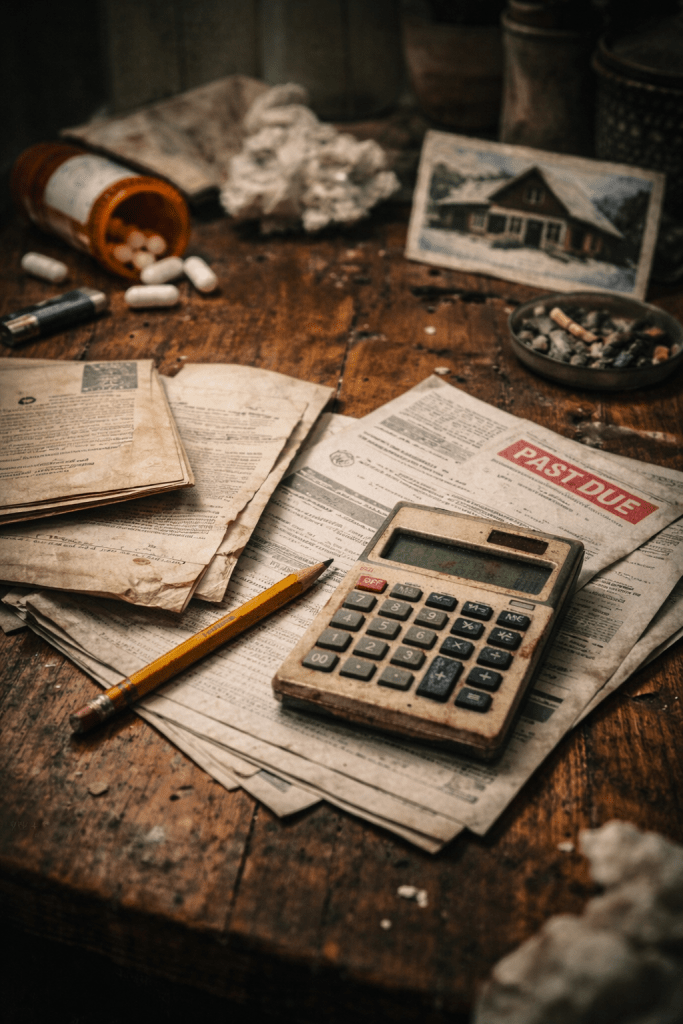
I also take a fingernail worth of Suboxone now. Back then they started me at eighteen milligrams — one orange film morning, noon, and night. Dr. Ritvo and the other woman (I can’t even remember her name just how relieved I felt telling her everything) called it standard. I had white-knuckled the comedown off fentanyl in the behavioral health unit at Ivinson Hospital, feigning suicide just to land somewhere padded, and then turned around and put opiates right back into my bloodstream.
They kept me in the detox unit to get me onto Suboxone. I shared a room with a woman who had completely fucked up her face while she was drunk. Her family had finally had enough. She had a suitcase and visitors. I had a plastic basin and a dose increase. It was a dorm room: two beds, no curtain. When I started puking it came out hard, not neat, not contained. She pressed herself against the wall like she could disappear into it.
Getting on dope is fucked up. People can tell how deep you are in it by how much you hork. I spent weeks vomiting in hotel sinks and trash cans when I first started using. It wasn’t that different from the vodka years, throat scorched, soul lit up. By day three at the detox, I felt the soft panty hose of opiates pulled over the legs of my life tightening around my stomach. I knew I would eventually have to come off this shit.
Around the same time Appalachian Catholicism was being trotted out on cable news, I became obsessed with my own hillbilly roots. The truth is I was raised Protestant and pretty comfortably, but I felt some kind of allegiance with poor folks as a coal miner’s daughter. Born in 1983, I grew up in a world where my dad’s paycheck could carry a house and a stay-at-home wife and still stretch far enough to cover what no one talked about.
My dad with his day trading. My mom with her deals. The glow of his computer screen ran late into the night; QVC boxes stacked up in the hallway. Meanwhile I was filling out FAFSA forms and signing for loan after loan, telling myself it was temporary. I worked through college at Sweet Melissa’s — cook, server, whatever shift they’d give me. The loans were for living.
When I was younger, I would fill out of the FAFSA every semester not understanding shit about it other than it generally ended up with Sallie Mae loans and extra cash that I could dash off to Denver with. For awhile there, I loved going with my gay friends to the fancier shops becoming designer adjacent but it was all a false reality. That money had to be paid back and part of the reason I’m writing from a hovel in Laramie with no heat.
I caught a glimpse of the FAFSA once. My parents were expected to contribute $11,000 a year. That never happened. They paid for one semester of dorms at UWyo and that was the end of that line. After that it was loan after loan from Sallie Mae, first at 4%, then 6%. A few years after Dad died, a process server knocked on the door looking for him. I was being sued for private debt.
It was more jarring to hear someone looking for my dead father than to have the debt. I didn’t tell my mom. I didn’t tell my uncle. What the fuck would they do? I had already been written off by folks as a fuck up. I knew a bit of my Dad’s finances before he died (mainly from the FAFSA, hah!) and knew he had to be making about 80-100k. He also used this number to tell me what a dipshit I was for choosing English as my path.
I also knew a little about the gambling. When private equity firms have the money and the experts, thinking your library book in stochastics gives you an edge is laughable. Dad, on the computer for hours and hours ignoring all of us, and Mom on QVC for hours and hours ignoring us. I can’t even fathom the amount of money that was spent but when it came to college—nothing.
My mom even made sure to test me all the fucking time when I was younger in regards to my aptitude.
I was trained early to measure worth.
If she knew I was a child genius or whatever why didn’t they set money aside?
This whole story started with a Facebook post about a girl in Montana. She’d bought and renovated a house. Before-and-after photos, white cabinets, new floors, snow stacked clean against the windows. I stared at it longer than I meant to. On a university salary. She’d just finished a second master’s degree. Her first master’s was in counseling, like mine. She decided she hated the field and pivoted. I did the math automatically. University pay isn’t generous. Degrees cost money. Renovations cost money. I decided to assume she had help.
Some days I don’t talk to anyone. No one messages. I’m not interested in crying about the lonely. That’s gone away. I’m more dismayed that I didn’t make it. I’ve skimmed so many wonderful experiences and still want to become a whitewater river guide, but I also know that I could end up just as empty at the bottom of the biggest ditch in the world crying like I did last time. Bless you, Grand Canyon.
I didn’t make it to the white collar class.
I didn’t make it to the white picket fence.
I didn’t make it to the white snow of the Rockies.
I did the math.