There are places that never recover from the moment they become a symbol.
They keep functioning—streets plowed, classes taught, houses sold—but something essential slips out of alignment, like a joint that never quite sets. You learn to compensate. You call it resilience. You don’t talk about what hurts when the weather changes.
That’s how Laramie feels to me now.
I came back expecting familiarity and found production instead. The outlines were right. The scale was wrong. From a distance, the town still looked like itself, but up close it felt thinner, as if something interior had been scraped away and replaced with a surface designed to photograph well.
I was born in Gillette, where work announces itself plainly and early, where nothing pretends to be delicate. In 2002, I moved to Laramie and stayed until 2016—long enough for the town to shape my nervous system, long enough to confuse proximity with belonging. When I left, I thought I was leaving a place. When I returned, I realized I was returning to a story already being told without me.
The first thing that stopped me wasn’t a person.
It was a house.
The house on Railroad Street used to be a dare.
In the early 2000s it sagged under its own age, a late–nineteenth-century structure that had never learned how to perform charm. The porch leaned. The boards were soft. The windows were filmed with dust and years of weather. You could smell it before you went in—sun-warmed rot, old paper, something animal, the unmistakable scent of long abandonment.
We’d push the door open with our shoulders and step carefully, afraid the floor might give way—not dramatically, just practically, the way you move across ice you don’t trust. Inside, sound lagged. Each step landed a fraction of a second late, as if the house had to consider whether it agreed to hold you. The boards didn’t creak for effect; they complained. You learned the dips by feel. You learned where the floor was weakest. You learned how not to ask too much.
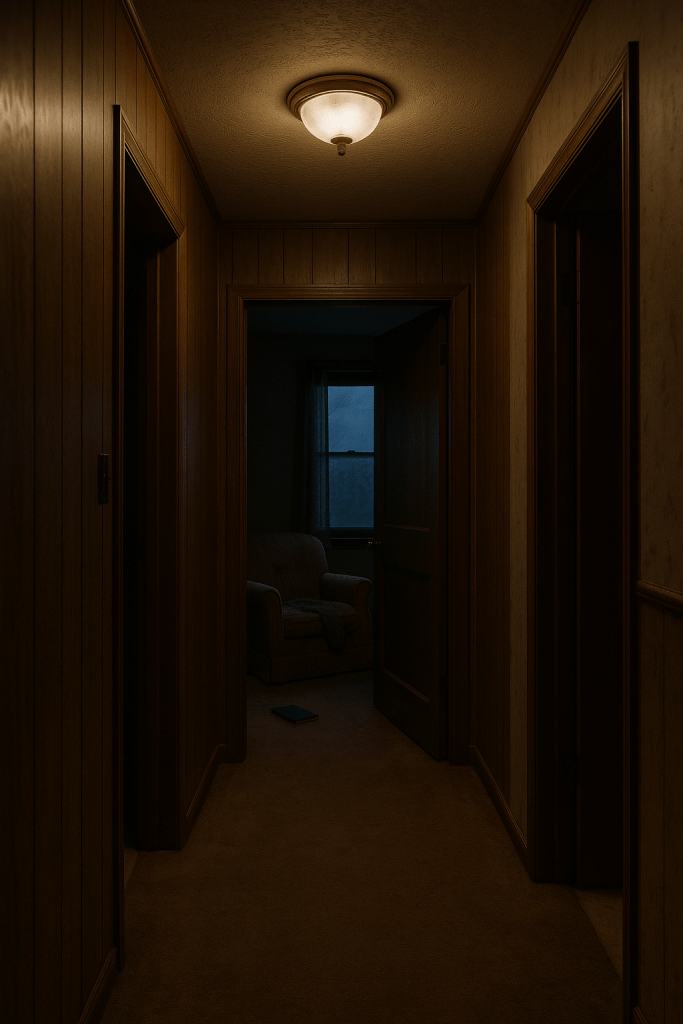
I remember the walls more than the rooms: flaking paint gritty under my fingers, plaster that crumbled if you pressed too hard, a doorframe warped just enough to make the doorway feel narrower than it should have been. Light came in dirty. Dust floated slowly, like the house was breathing on its own schedule.
It didn’t feel sad. It felt permissive. The house allowed error. It allowed curiosity. It allowed you to exist without proving anything.
That looseness mattered, though I didn’t yet have language for it.
When I came back years later, the house had been corrected.
New siding. New windows. The porch squared off and reinforced. Gravel where weeds used to grow. Every softness disciplined. It stood straighter, like it had learned how to behave in front of strangers.
I don’t remember the exact price—only the sensation of it, the quiet shock of realizing that fear had been converted into value. What once threatened collapse now promised return.
I stood on the sidewalk longer than necessary, trying to locate the place where I had once been afraid I might fall through the floor. There was no trace of it. Even the yard looked coached—contained, legible, resolved.
That was my first clue that I wasn’t just returning to Laramie.
I was returning to a version of it that had been produced.
The West Side—right over the tracks—has always been misread. People talk about it now as if it were a blank slate, as if its small, tightly spaced houses were an aesthetic choice rather than a historical one. Those houses were built small on purpose. Mexican and Mexican American families were pushed close to the railroad, close to industry, close to work that didn’t come with leisure or long-term security. City maintenance thinned there. Investment passed it by. Neglect wasn’t accidental.
What grew out of that wasn’t picturesque. It was relational. Families fed each other. Yards blurred together. Kids knew which houses were safe. The neighborhood took care of itself because no one else was going to.
That kind of culture doesn’t survive being rebranded.
Now the West Side feels like a set dressed to resemble “the West.” All reference, all surface. Like an old Hollywood Western where John Wayne rides through a town that never has to live with the consequences of his violence. The buildings look right from a distance, but the scale is wrong. The intimacy is gone. The houses are still small, but the prices are not. The people who made the place legible to itself are being replaced by people who need the place to perform.
I used to walk the neighborhood in the mornings with my dog, Angel.
Birds came first, loudest near the Lincoln Center where the old trees still stand. Their calls overlapped and argued, sharp and territorial. Then came the dogs behind glass, nails clicking against window sills, bodies launching at whatever passed. Sometimes a human voice, flat with repetition: shut up.
Angel always slowed near the boarded church.
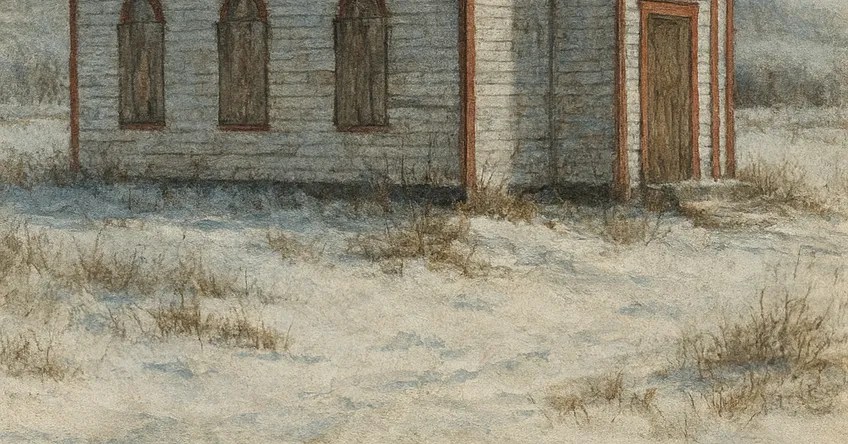
It doesn’t look ruined. It looks paused. Plywood covers the windows from the inside, cut unevenly, grain running in different directions, as if the decision was never meant to last this long. Snow gathers where people once scraped their boots. Power lines still run to it, as if the city hasn’t quite accepted that whatever lived there no longer needs electricity.
Feral cats slip in and out of the basement through the egress. Angel would lean forward there, ears tilted, curious. I never let her stop. Curiosity has consequences. The cats weren’t symbolic. They were just trying to live.
Next door sits another boarded building, newer, with a satellite dish still attached, tilted skyward like someone shut the door mid-sentence. It’s one of the last boarded places on this side. There used to be more. Anything close to downtown gets bought now. The boards come off quickly.
Some mornings, when I don’t walk, I drive.
Past the house on Railroad Street. Past places that once felt unfinished and now feel resolved in a way I don’t trust. One day there was a husky in the yard of that house—thick coat, pale face, eyes so similar to Angel’s that she stopped short and tilted her head. Same alert softness. Same question-mark posture.
That unsettled me more than the renovation ever did.
Not because the house had been fixed, but because it had become ordinary again. Lived-in. Claimed. The kind of place where a dog might nap in the sun. No longer provisional.
I keep wondering why it costs so much now.
The streets are still uneven. The wind still rearranges you. Downtown has been polished just enough to photograph well, but step one block off the main drag and you’re back in a town that hasn’t fully decided what century it belongs to. Infrastructure limps. Services thin out quickly.
And over all of it hangs the thing no one wants to touch anymore.
Matthew Shepard.
The town never repaired from that—not really. It tried to outgrow it, outbrand it, soften the edges. But the crime fused too cleanly with the place. The geography matched the violence. The isolation. The way harm could happen and be carried out into the dark without interruption.
Laramie became a lesson instead of a location.
People learned just enough about it to feel informed, then stopped listening. The town learned how to perform progress because performance felt safer than excavation. Pronouns appeared. Statements multiplied. Prices rose.
There’s a therapy practice here that presents herself as grounded, inclusive, careful. Pronouns on the page. Mountain language. Wellness aesthetics. And fees that none of the families who built the West Side could ever afford.
It isn’t hypocrisy. It’s extraction with better branding.
Long before I had language for any of this, I cared about extinction.
I was ten years old, in a gifted-and-talented program, competing in Odyssey of the Mind. We built fragile balsa-wood structures that had to hold weight. We wrote plays about complicated problems—environmental, civic, moral. The point wasn’t winning. The point was thinking.
Our team chose the black-footed ferret.
At the time, it had been declared extinct and then—barely—found again in Wyoming. A ranch dog brought one home. That was how the story restarted. Not with a plan. Not with a speech. Just an animal crossing a threshold.
In our play, I was a poacher.
We were ten years old, trying to understand how something could disappear without anyone meaning for it to happen. Trying to understand how care could arrive too late and still matter.
That shape has never left me.
Extinction isn’t drama. It’s narrowing. Life pushed into smaller spaces. Survival dependent on being unnoticed.
At the vet, Angel pressed her weight into my leg the way she does when a room smells wrong. The floor was slick. She shifted carefully.
I was already crying—quietly—when a woman in a mask said my name.
It took me a moment to recognize her.
Angel’s old babysitter.
Her Rover profile had vanished weeks earlier. One day there, the next gone. No message. No explanation. I had wondered if Angel had done something wrong. If I had.
We separated politely. No argument. No repair.
Wyoming is very good at this.
At home, a squirrel startled when I opened the door too fast. Instead of choosing ground or tree, it chose air—belly exposed, legs splayed, a brief refusal of the available options. Then it landed and disappeared.
The moment stayed with me not because it was brave or symbolic, but because it was efficient.
Some things survive by learning how to vanish.
Some disappear by being made present in the wrong way.
The house on Railroad Street stays finished.
The church stays boarded.
The cats keep moving in and out of the dark.
I don’t think about healing anymore. I think about what remains unrepaired—and why.
Because some damage, if you rush to fix it, only gets buried under better lighting.
 the misfit west