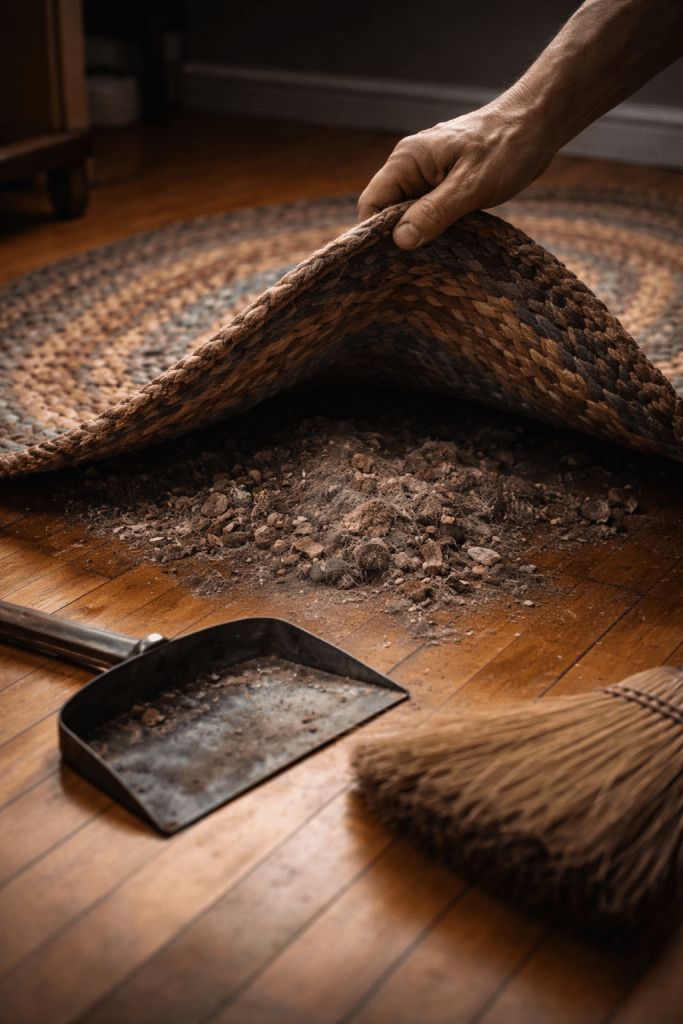
I used to want my writing to be lyrical and polished, full of descriptions and rife with a lesson. Now, with the advent of AI, I find myself spending mornings yelling at a machine: DO NOT CHANGE THE ORDER OF MY WORDS YOU STUPID FUCKER THIS IS IMPORTANT STOP CHANGING MY WRITING. There’s a woven braided rug in my brain that fits the dustpan of my life so perfectly I forget about the dirt gathering underneath, the angles of my thoughts curving full and rounded around whatever I’ve shoved below. Under the rug, under the rug. Shove it all away.
Now I aim for my writing to stay human and keep its rhythm. I want the reader inside my brain, inside my existence, moving forward word by word, except nothing is that visceral anymore because everything is online. Understanding is never the final goal. Only survival. The hope is they make it through the Drake Passage of my writing: through addiction, through isolation, through years that tried to swallow me whole. Some of us never stop crossing.
Slogging away trying to get this piece going, so I’ll give you the thesis straight: fuck folks who are buying investment properties. I’ve yet again got an unstable housing situation because I’m sensitive to noise, I’ve got a hair-trigger temper, and drywall is thin in these properties owned by girls ten years my junior. Life is a random lottery of meaningless tragedy and swallowing your pride becomes an art when you’ve tried to be done with the scratch tickets, the fuckery, the liars, the waking up scared not knowing if you’ll have a place to live.
The truth at the bottom isn’t that I’m an exceptional person living out my values, refusing to become part of the problem. It’s more likely I’m lazy and I find it satisfying to live on the edge, no burnout train required. I would rather stand in line at the rescue mission food pantry than take a check from another person for a place to live. The other day I turned out of Whole Foods and handed a twenty to the man in the median. He said, oh man I just got out of jail, thank you so much, and I told him I wasn’t sure I’d have a place of my own in a few months either. I don’t give a fuck if he went and got drunk on my dollar. I hope he did.
That’s my problem. I’ve had so little that when I have a lot I want to give it away. I’m barely housed but I’ve fired up my Couchsurfing profile, ready to offer a roof to anyone passing through. It’s not like it used to be in the world of surfing couches. Maybe I’m too old, maybe we’ve all aged out of couch guests. Either way I’m pushed out of spaces over and over, and the smell of my dog’s fur has become my home. In the small moments I start to feel safe I sink back into the couch and wonder if I’ll ever live in a space larger than a hotel room. The agoraphobia has become a personality trait, and the smaller the better. But life didn’t want me small, at least not physically, and so I’m left incongruent, trying to shove my spindly limbs into spaces small enough that I won’t be noticed, won’t be a problem to eradicate. But sometimes being a problem means being alive.
Being alive leaves marks. Some are easy to clean: the black rubber of street shoes on a gym floor, fluffs of dog fur in the air, the indentation of a body on a bed with no frame because it’s moved so much. I’ve learned to measure a space by how fast I can retreat. The pleasure of counting steps across the living room curdles fast into the horror of how much there is to move. I’ve stopped decorating. I arrange myself in corners, bring my computer, start humming. A single desk. Shoes lined up in exit strategy. Life in a few Rubbermaid containers.
The landlord stopped by the other morning, pretty sure to check the drywall (FUCK), and I keep wondering what she saw that made her decide not to renew. I feel my cheeks go warm: was it the bare walls, the pictures half-up because command strips don’t hold? The missing bed frame. The secondhand desk. The books on the floor. What is it that I own, what is it that I’m lacking. Maybe if I were more put together, I could stay.
I’ve done my best to pick furniture I can carry alone. Help that isn’t paid rarely comes, so everything is collected and kept with the hope it will make it in the back of a U-Haul. Heirlooms crack not because I don’t care but because life barrels forward and I’m chipped, too. Everything is second-hand now. Even me. The furniture isn’t heavy but the thought of whether this will be the time I can stay becomes heavy as the world, and I’m lifting with my knees instead of my back.
For two more months I’ll let my things sit where they belong for now: books on the floor, a single chair for everything, dishes put away, cookbooks in the corner, pictures on the floor or in the closet. Unfinished. In flux. I’ve got terrible regrets about a credenza left in Denver, records sold too cheap to a friend with several houses to store them, a cat taken from me with no goodbye, a soft hoodie with big pockets. Some nights I lie with my eyes closed and the thought of something lost enters and I feel my heart spread out in my chest, pumping with the blood of regret. No matter how big the rug, the dirt always comes back.
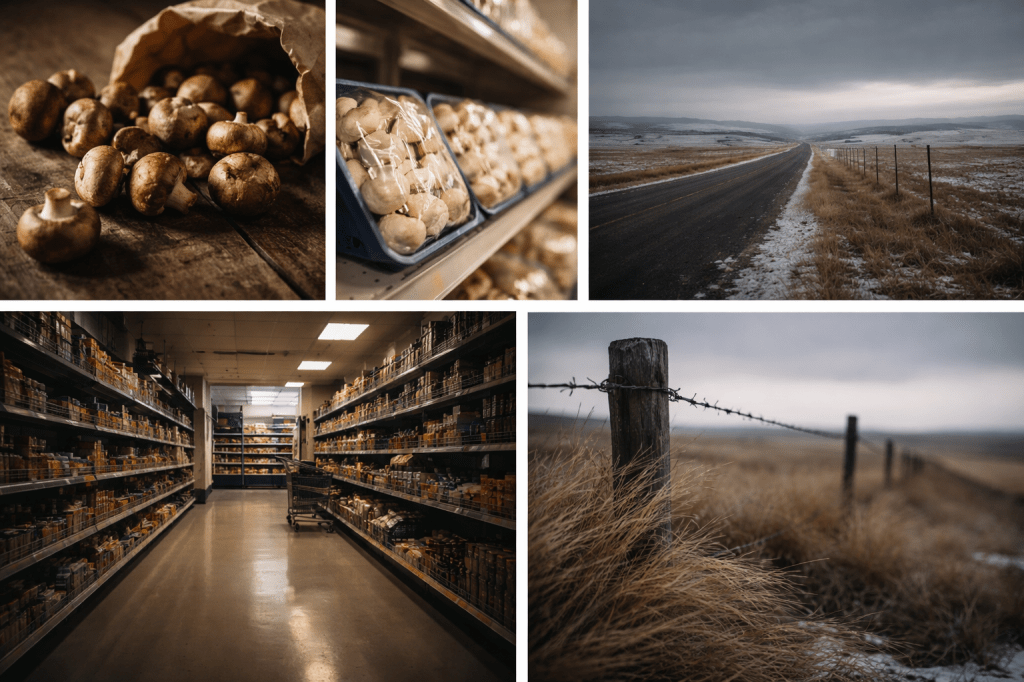
The mushrooms are separated by plastic. The white button mushrooms sit sealed and identical, pale under taut film, each one interchangeable with the next. They look like what grocery stores like to sell: clean, standardized, anonymous. I lift the package, feel how light it is, how little resistance there is to it, and put it back. My dog lets out a small “woo” and nudges the foam package with her nose, sending it sliding into the identical containers behind it. I say, “you’re right, you’re right,” agreeing with the dog, who has no knowledge of mushrooms and only cares about scraps later.
The local mushrooms are loose. Crimini. Soft in the hand. Springy. They don’t match each other. Some are wider, some darker, some still holding a trace of soil in the creases. I scoop them into a bag and think about not slicing them at all. I imagine them whole, leaning against a pile of potatoes, browned slowly, gravy thickening around them. Mushroom gravy. Lentil loaf. I’ve claimed vegetarianism again—part conviction, part refusal—after what I saw in Nebraska. After Tyson. After the way animals and people are handled until they resemble units more than lives.
Farmers come to mind. Hands that still touch what they grow. And then the hands that don’t. Production, not the store. The place where animals stop being animals long before they stop moving. The line. The speed. The work divided so finely that no one carries the whole thing. One cut. One lift. One motion repeated until the body performs it without asking.
Patterns emerge both back at the Tyson plant in Nebraska and here in Laramie at the food co-op.
In both places, the jobs closest to the animals belong to people who arrived recently. People who speak quietly or not at all. People who know better than to slow the line. Their presence is tolerated because it is temporary, because it is replaceable, because it holds the system together just long enough to keep moving. Sociologists call this flexibility. Towns call it opportunity. The people inside it learn a different word.
Above them, supervision. Clipboards. Fluency. Authority that never touches blood. People who can stop the line but rarely do. Hands clean enough to eat afterward without thinking.
Above that, offices. Light. Meetings. Decisions made far from the floor but justified by it. Yield. Risk mitigation. Language designed to smooth what it never has to witness.
And then the town, the town I live in now. Laramie.
A town arranged around the certainty that this is how things work. That this is what employment looks like. That this is what keeps doors open and checks clearing. A town that learns quickly which questions stall the line and which ones are better left unasked.
Researchers describe places like this as high in bonding and low in bridging. Strong internal ties. Weak tolerance for difference. Deep familiarity paired with shallow permeability. It shows up less in what people say than in how quickly they close ranks.
Fatigue settles unevenly. In some bodies it looks expected, even respectable. It grants space. It sharpens authority instead of dulling it. Irritability passes without comment. Repetition reads as history. Resistance reads as experience. And my body becomes a symbol of resistance.
I know I should dress better, use make-up but I’ve become so wary of the way eyes drift over my 6’2″ frame and my power comes from whatever sexualized version of myself that has started to plant in the minds of men who see me as new. I had their numbers the last time I was here.
In other bodies the same slowing draws scrutiny. It asks for explanation. It suggests instability. The identical posture, the identical tiredness, lands differently depending on who carries it. If it were a man dressed in a suit or if it was a whole black lab instead of my crippled husky and my underdressed self, maybe we would have authority.
By the time food reaches the store, the sorting is finished. By the time I reach the store, my value has been predetermined.
Who touched it. Who touched me.
Who watched. Who ignored me.
Who decided. Who ghosted.
Who benefited. Who’s marginalized.
Who was never meant to be visible. And I can’t seem to make myself small enough.
The white button mushrooms make sense in this order. Uniform. Wrapped. Nothing about them asks where they came from or who handled them or what it cost to make them so clean. They move quickly. They don’t interrupt anything.
The local mushrooms don’t move that way. Someone had to know the land. Someone had to risk irregularity. Someone had to accept loss. They require a different pace, a different tolerance.
The bag fills. I tie it.
That’s when I hear it.
You can’t have your dog in here.
I say what I always say.
She is a service animal.
There’s a pause. A look. The kind that finishes its assessment before you’ve noticed it start. The up-and-down scan. The question that doesn’t need words.
The person speaking isn’t a stranger. I know them. First and last name. History. Familiarity. I had assumed alignment. This was the farm-to-table store I’d chosen deliberately, drawn by its language, its friendliness, the suggestion that community extended beyond signage.
Only then does it occur to me that the evaluation likely began when I walked in.
The mushrooms feel heavier.
I leave them on the counter.
After that, I start noticing how many places ask me to explain myself.
Not directly. With posture. With pauses that last just long enough to register. With questions asked twice, then again, each repetition tightening the room a little more. This is how gatekeeping works now—not through refusal, but through delay.
Someone speaking louder than necessary. Someone gesturing instead of answering. Someone addressing the dog before addressing me. Someone stepping back as if proximity itself requires permission.
None of it becomes an argument. It accumulates instead. A running tally of how much room I’m allowed to take before I begin to cost other people something.
I start timing my movements. How long I linger. How slowly I bend. Whether the dog’s body crosses an invisible line that makes someone else uncomfortable. Urban planners would call this friction. Therapists call it hypervigilance. The body just calls it learning.
The thrift store follows the same pattern. Same posture. Same disbelief. I had been there the day before sorting out a membership issue—three hundred dollars, lifetime, already paid—only to be asked again if I was sure I was who I said I was. Name. Phone number. A record in their system for over a decade because I’ve never changed it.
Are you sure this is you?
Being known and being recognized turn out to be different things.
I’ve lived here before. For years. Long enough to learn the wind, how it scrapes the face in winter, how it carries sound across distances that look empty but aren’t. Long enough to know how the town contracts when days shorten, how social life thins, how people retreat without saying so. Long enough to understand that winter’s hardest part isn’t the cold, but the slowing that never quite softens.
I left.
Not dramatically. Not with a declaration. Just the accumulation of knowing I’d reached the edge of what this place could offer me then. I left to get trained. To learn. To acquire language and tools and ways of being useful to people whose pain I could finally name.
Elsewhere, the training mattered.
Institutions adjusted. Conversations stretched. Experience accumulated forward. Sociologists describe this as circulation—knowledge moving through systems and changing them slightly each time it passes.
When I came back, that movement stalled.
Questions landed cautiously. Suggestions drifted without anchoring. Conversations circled familiar ground. Skill was reinterpreted as temperament. Experience earned elsewhere arrived already suspect. Credentialing didn’t elevate me here; it unsettled the hierarchy.
Duration carried more weight than range. Familiarity outweighed competence. Staying—even unhappily—counted more than leaving to learn and returning changed.
Nothing dramatic marked the shift. Invitations thinned. Silence grew denser.
Paths were worn deeply enough that deviation showed immediately. Adjustment slowed things down. Care complicated the flow. Closed systems protect themselves by exhausting those who try to widen them.
I walk with a dog who moves slowly. She lies down and waits. She does not bark. She does not approach anyone. She does not demand attention. Need becomes visible simply by her being there.
That visibility changes how everything else is read.
Independence is prized here. Self-containment. The ability to move through space without asking it to change. Anything that interrupts that story draws attention, not because it is loud, but because it refuses to disappear.
I begin keeping a list.
What moves easily:
familiarity
endurance
uninterrupted presence
contained emotion
bodies that do not require pause
What does not:
experience earned elsewhere
returning altered
care work
untranslated critique
visible limitation
Nothing about this sorting is announced. It happens politely. Procedurally. Through tone, repetition, and disbelief delivered calmly.
The same logic repeats outside the store.
Housing works this way. Availability is discussed as if it’s fluid, but rooms don’t move much. Leases circulate among the same hands. Exceptions appear briefly and then withdraw.
Professional space follows suit. Offices change names but not rhythms. Programs rebrand. Language updates. The rooms stay calibrated to the same pace, the same assumptions about who needs what and how much time they’re allowed to take asking for it.
Care is welcomed in theory. In practice it’s met with impatience. The work that moves fastest is the work that doesn’t linger. Anything slower begins to feel like obstruction.
Training sharpens the contrast. The more language I carry, the clearer it becomes which rooms were never built to hold it. Which conversations stall the moment something unfamiliar enters.
What looks like openness functions more like display. Yard signs. Mission statements. Posters about inclusion taped to walls that haven’t changed in decades.
The welcome stops at the threshold.
I stop trying to explain myself into these spaces.
Explanation only widens the gap.
The jokes about not moving here circulate easily. Protective humor. A way of guarding value where margins are thin. Things cost a lot. More than they should. The access people cite doesn’t justify it. Still, the insistence on specialness persists.
For someone without inherited belonging, who learned early that place would have to carry more weight, there isn’t much here to hold on to.
That doesn’t make the place bad.
It makes it exact.
I think again about the mushrooms left on the counter. The sealed ones, perfect and untouched. The irregular ones, alive and unfinished, set aside once the assessment was complete.
Later I cook something simpler. Or I don’t cook at all. Hunger gives way to clarity.
Understanding what a place cannot offer steadies something.
The question changes.
What kind of movement is allowed here?
Once that becomes clear, leaving stops feeling like failure.