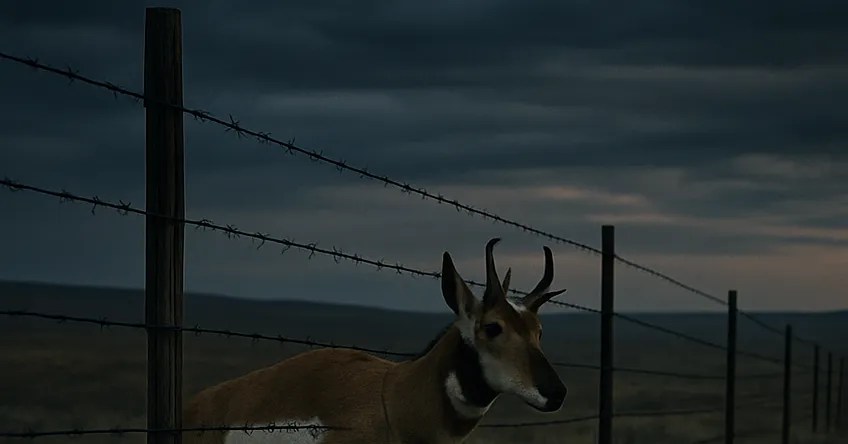
The pronghorn were already gathering along the fence line when the wind shifted—tight, jerking movements like something had startled them miles before I ever arrived. Wyoming wind always brings news too early; it ruins surprises. It carries the scent of death the way a river carries silt: efficiently, without apology.
I pulled over on the shoulder, gravel giving under the tires. Out on the basin, the animals held themselves in that half-lit alertness, the twilight hour where everything is both alive and almost gone. Their bodies twitched: a muscle memory from predators that don’t exist anymore. American cheetahs, long-toothed cats, those fast ghosts that evolution built them for. Creatures so fast their shadows must’ve cracked like whips across the old grasslands.
None of those predators survived.
The pronghorn did.
That’s the punchline.
Scientists say pronghorn run fifty-five miles per hour because their bodies still believe in a world that ended ten thousand years ago. A world of teeth. A world where hesitation meant blood.
But the ghosts—oh, the ghosts stayed.
In Wyoming, things don’t die right.
They just hang around, changed into something else.
—
The herd kept throwing glances at the fence. A senseless hesitation. You see it when you’ve lived here too long: how animals keep faith with vanished pathways. How they push their soft muzzles against barbed wire as if the wire is the mistake, not the memory.
The lead doe stepped back, pawed the earth, lunged again.
Stopped.
The kind of stop that isn’t surrender—just a recalibration of desperation.
I’d done the same thing once.
Pressed my life against the same thin barrier over and over, thinking persistence could undo architecture.
That was the year I loved a man who carried a gun like it was part of his circulatory system. He’d been in a band—the ghosts of predators past—which felt poetic then, like we were living inside a metaphor we’d both agreed to believe. He talked about resurrection, survival, bloodlines older than the mines. But the night he put the barrel to my face, there was no poetry. Just breath, metal, and the awful recognition that he would always move faster toward violence than he ever moved toward love.
He’s extinct now.
Not dead—just gone the way predators go in the American West.
Absorbed by distance, dust, the narrative pressure of a place that eats its own history.
But my nervous system didn’t get the memo.
It kept running.
That’s the trouble with ghosts:
evolution doesn’t shake them loose just because the body survives.
—
The pronghorn jerked, bolted a few feet, stopped again in that tight cluster of mistrust. Even the wind seemed to hesitate, unsure which direction to turn its face. The sky had that sickly bruise at the horizon—the color Wyoming gets before it decides whether to kill something or let it walk away.
They say migration is instinct, but out here it looks more like compulsion. The strangest part is how these animals—the fastest in the hemisphere—get trapped by the slowest things: barbed wire stapled by a rancher who died decades ago, an interstate pouring east-west like a scar no pronghorn ever asked for, a subdivision named after the wildlife it displaced.
Speed doesn’t save them.
Speed betrays them.
It lures them into running headlong into human geometry.
I know the shape of that betrayal.
It has the dimensions of a childhood home, of a house in Centennial with legal documents stacked like teeth, of every Wyoming hallway where silence pressed harder than fists.
Outrun the thing too long and you lose the ability to understand what’s chasing you.
—
A semi roared by and the pronghorn flinched in collective panic. One young buck tried to run toward the road—pure instinct, pure velocity—before a doe cut him off with a sharp, decisive arc, saving him by accident or old knowledge. They wheeled again, bodies moving like punctuation in a sentence written before the concept of fences.
The fence, though, stayed.
Fences always do.
This is the part of Wyoming no one writes about in travel magazines: the land is haunted by its own miscalculations. We built barriers the old predators never imagined, rewrote the chase, stripped out the teeth, left only the running.
So now everything runs.
Animals.
Families.
Women with dogs in the backseat of cars heading west at dawn, hoping the next town will be the one where the ghosts finally lose interest.
But ghosts don’t get bored here.
They settle.
They nest.
They become local.
—
The doe finally found a weakness in the wire—a sagging place where weather and neglect had worked together in slow conspiracy. She slipped through, ribs brushing the metal. One by one, the others followed, bodies folding and unfolding like secrets escaping through a too-small doorway. A few scraped hair from their backs, a minor blood price. Out here, every crossing requires flesh.
I watched the last pronghorn hesitate, trembling.
She looked directly at me—those black, ancient eyes—and for a second I felt something rare: not recognition, but mutual assessment. A kind of shared acknowledgment that neither of us were built for the world as it is.
She went through.
Left a tuft of hair on the barb.
Didn’t look back.
The herd reassembled on the far side and moved off into the sage, dissolving into the land the way Wyoming creatures do. First they’re there; then they’re legend.
—
People like to claim Wyoming is empty.
It isn’t.
It’s crowded with absences.
With things that should have died but didn’t, and things that should have lived but couldn’t.
Some days I feel like one of them:
a pronghorn built for a chase that ended before I was born,
a woman built for a family that couldn’t hold her,
a survivor keyed to the breath of a man who is miles gone but somehow still pacing the dark edges of my brain.
But I’m learning something the pronghorn never will:
Ghosts don’t need to be outrun.
They need to be watched until they flicker, until their outlines distort, until you realize the world has shifted again and the danger you were built for is not the danger you face.
The old predators are gone.
We’re the ones becoming ghosts now—
moving fast, crossing wire, dissolving into the landscape,
carrying the memories of teeth in bodies that still haven’t learned how to slow down.
Whether that’s tragedy or evolution, I don’t know.
But out here, on this wind-scoured road with the last light dying, it feels like truth.
And in Wyoming, truth is the only thing that ever stays.
 the misfit west