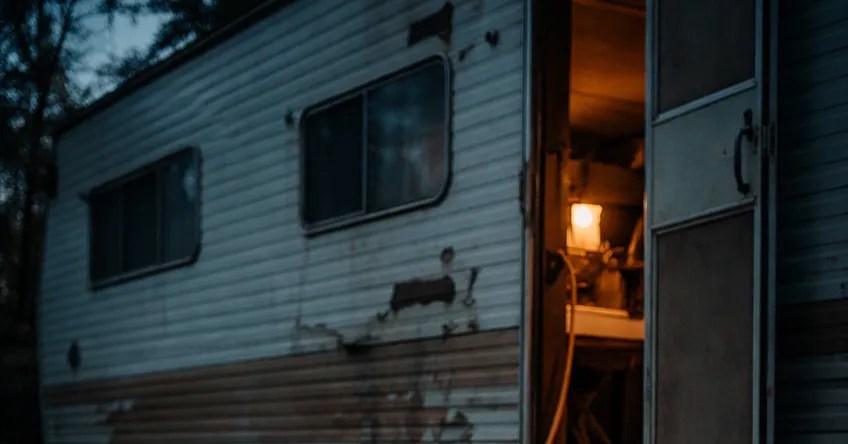
The camper sat where things went to disappear. Not hidden—just off to the side, behind cottonwoods that never thickened. Wind moved through them like it had permission.
It had once been a camper. That was the rumor. He’d stripped it down and rebuilt it without finishing anything. Walls opened into nothing. Wires crossed where shelves used to be. Plywood met plywood and didn’t line up.
Nothing had a final form.
A rearview mirror was screwed into the bathroom wall. Crooked. Beneath it, a hose hung loose, looping into a plastic bin. The bin held water when it felt like it. The floor dipped there. I learned where not to stand.
There were hookups—electric, water—but they felt provisional. Like a favor that could be revoked mid-sentence. I kept waiting for a sound that would mean the whole place had decided to quit pretending.
We were cleaning.
Cleaning meant shifting objects so the floor could be seen briefly. Tools without pairs. Screws loose in mugs. Ash in places ash didn’t belong. Old food bags folded small, like they were trying to behave.
I wiped the counters. The surface was already ruined, but I wiped anyway. Habit. A way to keep my hands occupied.
The air carried a sharp, sour heat. Chemical. Burnt. The microwave was plugged into an extension cord that ran under the door. I noticed that and filed it away. I noticed a lot of things and didn’t say them.
I had moved in because there was nowhere else.
That wasn’t a confession. It was a fact, like the wiring.
I slept dressed. Shoes stayed by the door. My bag stayed zipped. I learned how to move through the space without brushing against too much. When I stood still, the place felt unstable—not collapsing, just waiting.
He moved easily inside it. Like it made sense. Like this was how things were supposed to be arranged.
The microwave light clicked on.
My phone turned slowly behind the glass. Once. Again.
The sound was ordinary. That was the problem. The low hum, the small motor doing its job. The room didn’t react. Nothing tipped. Nothing cracked.
Outside, a truck passed. Gravel shifted. Then it was gone.
The smell changed quickly—hot plastic, something metallic, bitter at the back of the throat. The microwave kept going.
He stood close. Close enough that I could smell old coffee on his breath. Close enough that I didn’t step back.
I watched the phone spin. I watched the time pass without numbers.
When it stopped, the room stayed the same. Counters. Floor. Mirror. Hose.
Later—much later—the smells started showing up in other places. Bleach. Ozone. Warm dust. Appliances made me pause. The sound of fans stayed too long in my ears.
I cleaned more carefully after that. Slower. As if moving wrong might wake something.
Time passed the way it does when nothing interrupts it. Days stacked. Nights folded in on themselves. I learned which boards flexed and which held. I learned which silences were normal.
When I left, I didn’t take much. The phone was already gone.
Sometimes now, a microwave hum will catch me off guard. Not fear—just attention. The way the body keeps a list it never shows you.
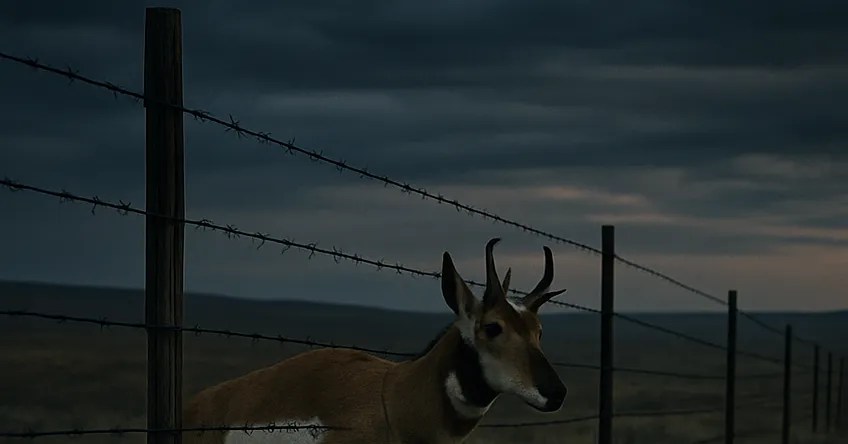
The West likes things that look unfinished. It mistakes exposure for toughness. It calls improvisation resilience.
The camper is still there. I drive past it sometimes. The cottonwoods haven’t filled in.
I don’t stop.
Morning came without fixing anything.
I drove into town with the windows down even though it was cold. My phone was useless now—hot, warped, wrong—but I carried it anyway. Habit. Proof. I parked at Jack’s Liquor because it was open and because I didn’t know where else to go.
Inside, the floor was sticky in the way liquor store floors are. Bottles stacked too high. Fluorescent light that made everyone look unfinished. I asked about a phone. The man behind the counter shrugged. Not unkind. Not helpful.
Outside, the wind pushed at my back like it wanted me gone too.
When I drove back, my things were already in the yard.
Clothes. A bag split open. Papers lifting and dropping like they couldn’t decide what mattered. Nothing broken. Nothing arranged. Just displaced.
Something in me went loud.
I don’t remember deciding to scream. It was already happening by the time I crossed the line where the yard turned into dirt. My throat opened and didn’t close again. Sound without shape. Sound that didn’t care who heard it.
The motorcycle was leaned on its kickstand near the camper.
Black. Heavy. Too confident in itself.
I didn’t think about it. I put my shoulder into the metal and used everything I had—legs, back, the stored-up effort of not asking for help, of sleeping dressed, of waiting for things to fail. It tipped slower than I wanted, then faster, then it was down.
The sound it made was final.
I went inside still screaming.
The back area where the bed was cut off from the rest of the space by a half-wall that didn’t reach the ceiling. Light pooled there differently. Dimmer. Closer.
That’s where he was.
He reached down and brought up a sawed-off shotgun like it had been waiting. Short. Unreasonable. Pointed directly at my face.
I didn’t stop.
I didn’t flinch. I didn’t step back.
The screaming narrowed into words I didn’t recognize as mine until they were already gone.
The gun stayed where it was. His hands moved, then didn’t. The room held its breath. I don’t remember the sound of it leaving, only the door.
After, the space felt emptied out. Not safe. Just abandoned.
I took the change from a cup by the bed. Quarters, nickels, whatever fit in my pocket. I found a small bottle of whiskey tangled in the sheets. I took that too.
Outside, the motorcycle was still on its side. My clothes were still in the yard. The wind was still doing its job.
I didn’t stay to clean.
____________________________________________
⚠️ Reader Support & Content Notice
This essay includes reflections on experiences of coercive control, isolation, and intimate partner harm that some readers may find emotionally intense, distressing, or triggering. If you are currently in a situation where you feel unsafe, coerced, or under threat — or if this writing brings up past trauma — know this without sugar-coating: your safety matters more than anyone’s story.
You don’t have to endure harm alone.
If you are in immediate danger:
📞 Call 911 (U.S.) right now — your life and wellbeing are priority one.
National and Confidential Support (U.S.):
📞 The National Domestic Violence Hotline: 1-800-799-7233 or Text START to 88788 — 24/7 confidential support, safety planning, and referrals to shelters and advocates near you.
💬 RAINN National Sexual Assault Hotline: 800-656-HOPE (4673) or online chat/text options — trained listeners available 24/7.
Find Local Help:
🏠 DomesticShelters.org — searchable directory of shelters and support programs across the U.S.
Emotional and Mental Health Support:
📘 To Write Love On Her Arms (TWLOHA) — hope and connection for people struggling with depression, trauma, or crisis.
💛 Reach out to a trusted therapist, counselor, or mental health provider who uses trauma-informed care principles, which recognize how power, fear, and control shape survival responses.
If you’re supporting someone else:
Listen without judgment, believe what they tell you, and help them connect to professional resources at their pace.
You deserve support and safety. If this piece resonates, take a breath — and take the next step toward care that feels right for you.
 the misfit west