Tag: trauma

  • brown noise

    When I was about 25 when my Dad died in an accident in our home.  We were real close.  Daddy’s girl type stuff.  Mostly, we shared the same temperament:  angry.  Shortly after he had died I found myself in jail for drinking and driving which was bound to happen in my live fast die young give a shit world where I had started shooting up at the age of seventeen.  Anyway, landed myself in jail and that’s where it all started…

    When you arrive in booking, a few different things can happen.  So, you get arrested which can happen fast or slowly depending on the charge.  My experience was mainly performing drunk Olympics like a baby giraffe in high heels on the side of the road before eventually blowing (there wasn’t this big refusal trend back then) and joking with the arresting officers about what I might blow.  All fun and games until the drunk tank.

    Booking is the general area in the jail where you wait to see about placement.  There are usually a wide smattering of folks and on this night in Campbell County Detention Center the mix was meth heads, drunks, and a few immigrants.  This was before the immigrant crisis and Gillette had a sizable jail population compared to Laramie where I had just completed another stint in jail.  This was my second DUI arrest and they needed to put me in the general area of the substance use issues.

    The placement usually starts in an innocuous cell (unless you are in special management if that was the case you probably wouldn’t be reading this) where they hold you for a few reasons.  They like to say its to be sure you aren’t a danger to yourself or others and to monitor the general population but I’ll tell you a secret:  you are in booking as long as they want you to be.  Press that call button one too many times and you might be in booking limbo, a purgatory of screaming, yelling, and in case you haven’t lost all humanity yet:  the lights never come off.

    That’s how some of the most trying days of life started—in a booking cell with lights that never turned off.  The first night, they had stuck me in a cell with another woman who was clearly experiencing some kind of crisis (meth?) and wouldn’t stop scratching her arms and screaming, screaming, yelling, screaming, SCREECHING about how she needed a nurse, needed a call.  These ones are the most annoying because folks still think they have a choice at this time and it takes them a few hours to realize that you are screeching into the void.

    This is probably where the toilet paper started.  There’s not much amenities in jail and so I used to bunch up as much toilet paper as I could stand and shove into my ears and sacrifice feet warmth to be able to pull the blanket up over my head.  Because I was locked up on a second offense I was staring down a longer sentence:  about 6 months and I had yet to be sentenced in another county so this was truly the beginning of the journey after being arrested at home feebly calling out to my mother for my glasses who wouldn’t give them to me.  By the end of the sentence, the bunched up cheap one ply had started to make my ears bleed.

    The complainer in my cell was finally removed by morning and I took my chances asking a passing guard if I was headed to general population.  I had no idea at the time, especially just from looking around, but they had busted a huge meth ring the same night they found me and ended up inditing about 29 people.  When I read the article upon my release that first night made so much more sense and that toilet paper was my barrier between drunk and methed out.  Hope and compete disrepair.

    First night knocked out and they dragged me out of my cell to fill out the gen pop form where I mentioned my zero gang affiliations and zero dietary restrictions.  Later on, I learned that lots of prisoners would use the ol vegetarian trick to get better food.  Sadly enough, I would often get jealous of the pregnant offenders because they would get more food and two milks.  They would often barter for candy.

    After filling out my form and feeling hopeful that I might finally get the fuck out of booking and the constant screaming and 24 hour light I was placed in another cell for holding.  This time, there were four of us in the cell. During this time, Campbell County had started work on the detention center and they hadn’t finished the booking side.  The plumbing was not functional in every cell and ours was half functioning.

    Four women shitting across four days is a fucking putrid smell.  The second day wasn’t bad because these women were more lucid than the mether of the previous evening and they let us have copies of the newspaper and we chatted and folded paper.  We took turns sleeping in various areas of the cell but you could never really get away from the smell.  The cell was so small that no matter where you sat, laid, stood, your head would always remain about 6 feet from the toilet.

    On the third day we were all becoming restless.  We slept a bit that first night but the fluorescent lights seemed to posses a special type of psycholical warfare voodoo and the glare was slightly blue in this jail, orange in the Wheatland jail.  Another inmate and I decided to take the newspaper and whatever we had to put it over the lights.  Within the hour a guard was in our cell ripping it down.  No rest for the wicked.

    The fourth day was the test.  I hadn’t slept in days, food wasn’t always served on time or just not served at all and whatever was on the plate had to have been dog food.  I wish it were something I could describe in a Proustian way but it was slop.  Literal brown slop from tray to toilet where it couldn’t be properly flushed.  After the guards had knocked down our feaux sleep system I felt the panic.  Pain in my chest, tears stinging my eyes. I felt the edges of my brain wondering how could any human do this how could anyone be humanely piled into a cell with no plumbing and no food and come out the other side?  Well, baby, that’s the gen pop way—if you don’t hurt yourself or others during these four days you are free and clear to be housed in detention for as long as you make trouble for yourself.

    For the next day the task wasn’t to entertain ourselves it was to maintain some level of sanity so that we could all get the fuck out of this cell.  Slowly, one by one, like cattle in the feed lot headed to slaughter we were given our jumpsuits.  Blue for felons.  Orange for misdemeanors.  Stripes for trustees. I pulled the orange jump suit up over my legs and asked for a XXL mainly to have the suit long enough to pull over my limbs.  I looked like a giant loose noodle in a used car parking lot legs and hair flailing in deperation:  zero percent financing c’mon in today except what was being sold was our souls.

    I seriously doubt there was much oversight or complex manuvering to make our lives hell.  These were just people performing a job in a shitty system and I felt shame seep into my face when I would see a guard I went to high school with watching in silence as they patrolled the pod wondering how the fuck my life got so off course.  One morning, after working night shift in laundry we decided to move some chairs around in defiance of the felon fucks that wouldn’t let us sleep during the day.  Damn near got the unit shut down but this was a turning point where I no longer feared the blue suit felons and their cans of copenhangen snuck in through body parts.

    I ended up staying about 30 days in the Gillette detention and even could see some benefits:  we would get commisery twice a week and there was actually women in jail.  Around 30 of us in jail most for drugs, then child support, then a few who had gotten so fed up with their abusive husbands they shot them.  I asked my cell mate about her murder and she described the antique pistol she had grabbed from the mantel right before she shot in him in the stomach. 

    I remember thinking at the time that she didn’t look like a murderer. She looked like somebody’s aunt, hair pinned back, hands folded in her lap, the kind of woman who probably kept a clean house and paid her bills on time. She had never been in trouble a day in her life until that one moment when she reached for the dusty pistol that she said she didn’t even think would work.

    That stuck with me longer than the smell of the cell or the lights that never turned off. The idea that a life can change in the span of a few seconds. One bad decision. One flash of anger. One moment where the line gets crossed and there is no stepping back. One moment where the pain and suffering of an entire life distills into a tiny flash that forever marks the person.

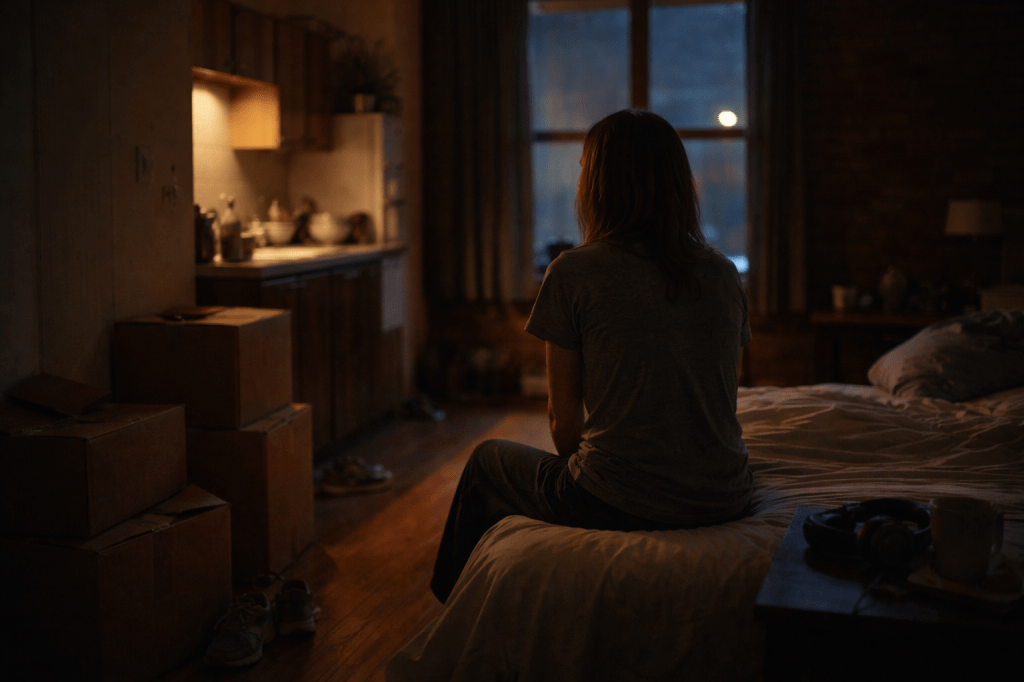
    Years later I would find myself standing in an empty apartment holding a notice in my hand saying my lease would not be renewed, realizing I had done the same thing in my own way. Not with a gun. Not with blood. But with a choice that landed just as hard. One small moment and she killed a man. One small moment and I killed my housing.

    The brown noise never really stopped after jail. It just changed shape. A low steady hum in the background reminding me how thin the line can be between a normal day and a life turned sideways. That girl in the jail cell never left. She is still here, listening, waiting, trying to keep the volume low enough to get through another day without breaking something I can’t put back together.

  • the roads that raised me

    The house I lived in then was barely five hundred square feet, and most days I could feel every inch of it. The narrowness wasn’t just architectural; it was the intimacy of a space that holds only what you need and very little extra. There was a comfort in that kind of minimalism, the way it forced an honesty about my life. I had enough plates for one person and maybe two. A coffee maker that sputtered like it was remembering something. My uncle’s television and a couch the color of a sunrise someone turned up too bright. And in the back room, the silhouettes of my mother, grandmother, and great-grandmother hung in a row, their profiles quiet and observing, like they were keeping a ledger only they knew how to read.

    That Thanksgiving morning was bright but cold, a typical Laramie contradiction. The walls hummed with the faint memory of warmth. My dog shifted in her sleep, three-legged and stubborn, her breathing soft enough to blend with the refrigerator. I had no intention of cooking. The holiday had become less about food and more about the stillness it allowed. For once, the world expected nothing from me.

    Despite the holiday, the house felt like an ordinary day — but the memories arrived anyway. They came in slow, not as ambushes but as invitations. I could open them without collapsing. That still surprised me.

    That day, the roads came back first.


    There were the roads to Burns, the long stretch from wherever I was living at the time — Cheyenne, Laramie, no fixed point — to that small house my grandparents occupied like it was a final frontier. Burns never asked for much. A few blocks of houses, plain and sturdy. A water tower. A horizon that pressed right up against the town’s edge as if daring someone to leave. But the house itself held enough texture to shape my memory.

    I think most about the times my dad drove me, especially the one where he let me take the wheel of my mother’s Buick. It was a rare permission. I had wanted to drive that car for so long, watching my mother grip its wheel like it was the only thing she trusted. The car smelled faintly of her: powder, gum wrappers, something else I can’t quite name anymore. Dad’s voice came casually from the passenger seat — go ahead, take it — and in that moment I was suspended between elation and terror.

    The sky that morning was split in two, one half blue, the other gray. It had just rained, the kind where the air feels rinsed, and every puddle on the pavement mirrored the sky. The Buick was heavier than anything I had driven before, and I could feel the suspension in my bones as I steered around the first curve.

    That’s when the hydroplaning happened — quick, slippery, a moment that lifted me out of certainty. The wheels lost their grip, just a fraction of a second, but enough that time stretched. I felt the car rise slightly, the steering wheel loosening in my hands. My breath caught. The interior lit up with morning light bouncing off the puddles, too bright for such a quiet scare.

    I didn’t say anything.

    I didn’t want to lose the privilege of driving.

    I didn’t know if my dad felt it too.

    He didn’t look at me, or if he did, I didn’t see it. He was staring ahead, trusting me more than I trusted myself. Eventually the tires found the road again, and I pretended nothing had happened. My heart took longer to land.

    That stretch of road — wet, shimmering, quiet — became part of my internal map. When I think of Burns now, I think of that sky, that split between blue and gray, the brief sense that the car and I had become unmoored.


    The actual house in Burns was its own character. There was the odd bathroom where the washer lived, with a hose snaking into the toilet because that’s how the plumbing made sense. Above it hung classic car calendars, the kinds with old muscle cars and women posed on their hoods. My grandpa didn’t care what month or year it was; the calendars stayed even when their dates no longer applied to anything. They were decorations of a sort, reminders of a world that made him laugh or dream or simply pass the time.

    His desk was the sacred part of the house for me. It was the only place I knew where every pen worked. Every marker, every calculator. Nothing scratched or stuttered. He valued function and he valued humor; The Far Side comics he tacked up or collected felt like extensions of him — absurd, dry, unexpectedly wise. I learned to see the world through those cartoons: cows with opinions, scientists in trouble, spiders having existential questions. The humor made room for my own quiet oddities.

    The basement, though, was the heart. It smelled faintly of dust and old paper, cool even in summer. The typewriter sat like a relic, heavy and sure of itself. My grandpa would sit down there and type letters to us, the keys clacking in rhythms that felt both chaotic and comforting. Sometimes insects got caught in the process — a deaf bumblebee, a squished spider — pressed into the margins like unintended punctuation marks. Those tiny marks of the basement accompanied his words across miles. They were not mistakes. They were signatures of the room itself.

    When I was driving to college with my dad and the Buick moment happened, I was leaving one life and entering another without knowing it. Burns stayed the same, though — watching from the edges of my adolescence with a quiet, steady love.


    The Vedauwoo dreams came later, threaded through the years when everything felt precarious. In the dreams, I was driving over the pass, the one between Laramie and Cheyenne, the granite formations rising like ancient teeth on either side. But the weather was always impossibly snowy, steeper than real life. The road would disappear beneath me, and suddenly I wasn’t driving anymore — I was sledding down the pass, sliding uncontrollably, the world tilting at an angle that made my stomach drop. The dream didn’t end in a crash or death. It just ended in motion, a sense of descent without resolution.

    Looking back, it wasn’t a dream about dying. It was a dream about losing control, about being pulled into adulthood faster than I could stabilize myself. It was the hydroplaning moment magnified and stretched into a landscape. Even in sleep, my body remembered that sensation of the ground slipping out from under me, the way fear can arrive without warning and then vanish without explanation. Those dreams always left me waking with the taste of snow in my mouth, as if fear had a texture.


    The roads to Gillette were their own education.

    Denver to Laramie to Casper to Buffalo to Gillette — each stretch with its own temperament. Some parts were monotonous, endless prairie that lulled me into thinking I knew what was coming. Other parts were violent in their weather changes, the wind pushing the car sideways, the snow hiding the ditches.

    There was one year when a storm hit hard enough that I couldn’t make it past Cheyenne. The snow was coming down in sheets, sideways, the kind of storm that feels personal. I turned the car around and ended up staying with my grandparents again. They opened the door like they always did — delighted, relieved, unguarded. It didn’t matter that the roads had forced me into their home. They acted like I had come intentionally, as if I had remembered something important about where I belonged.

    The house was warm in that familiar, slightly stale way that belongs to older homes — the furnace blasting, the air thick with old carpet and whatever had been cooked hours earlier. My grandma fussed over where to put my bag. My grandpa was already pulling on his heavy coat because storms always made him antsy, and he needed to walk a bit before bed.

    He had always been a walker. Even in his later years, when his steps had grown shorter and his back curved into its own quiet question mark, he insisted on walking the small blocks of Burns as if they were a duty he owed the world. By then, he wore Depends tucked under his jeans. Sometimes they sagged a little. Sometimes there was the faint smell of urine or worse — a smell he couldn’t entirely help anymore. It didn’t embarrass me. If anything, it made me love him more. It was proof of how hard he was trying to stay himself even as his body betrayed him. Proof that he still wanted to move through the world under his own power.

    I told him I wanted to stretch my legs after the drive, and he brightened. Really brightened. His whole face opened the way it used to when we were little and he’d say, “Let’s go get the mail,” like it was a grand outing.

    So we walked — slowly, carefully — into the kind of snow that makes all sound disappear. The storm had quieted for a moment, just long enough for us to step outside. Streetlights cast wide cones of light that caught the snowflakes in yellow halos. Our breath rose thick and white in front of us. The houses were dark except for a few porch lights left on as a kind of prayer for anyone still on the road.

    He waddled a bit, the way older men do when they’re trying not to slip, trying not to let their dignity fall out of their pockets. I matched my pace to his. Neither of us said much. We didn’t need to. His presence was enough — solid, gentle, aging but still unmistakably him.

    We didn’t walk long — maybe one block up and one block back — because the wind picked up again and the snow started needling our faces. But in that short stretch, something in me settled. I felt wanted. I felt chosen. Not for what I could offer, not for what I could perform, but simply because he was happy I was there.

    Back inside, he stomped snow off his shoes in the entryway and laughed at himself for being “too old for this.” My grandma handed him a towel. He took it with a seriousness that bordered on ceremonial, like drying off after walking me through a storm was the last important job he’d ever needed to do.

    Later, in the small bedroom where I slept under a quilt that smelled faintly of their detergent, I listened to the storm reassert itself. The wind pushed against the siding. Snow slapped the windows. But inside, I felt held in a way I hadn’t felt in years — not rescued, not fixed, just sheltered.

    That’s what comes back when I think of that storm — not the fear of the roads or the whiteout conditions or the way the car fishtailed on the exit ramp.

    I remember the walk.

    I remember his pace.

    I remember how deeply I loved him.

    I remember how safe I felt next to a man who smelled a little like aging and diapers and winter air — and who, without saying a word, made me feel like I was worth coming in from the storm for.


    I think sometimes about the night before I left home for college. I was in the basement room, the one with the waterbed that sloshed whenever I shifted, the one that always felt a little humid no matter the season. I had packed most of my things into boxes I wasn’t sure would fit into the car. The room felt smaller that night, like the walls were aware I was leaving and wanted one last chance to close in on me.

    The basement had always been my refuge and my exile — the place I could disappear into, away from the tension that lived upstairs. It was where I learned to stay small, where I tried to make myself into someone my mother might like more, or at least dislike less. But that night, with the boxes lining the floor and the waterbed gently shifting under me, I wondered how often I would come back. I wondered what would happen to the version of myself that had grown up in that dark, low-ceilinged room.

    I fell asleep knowing everything was about to change, though I didn’t have the vocabulary for it. Growing up is a slow burn until suddenly it’s a door you’ve walked through without realizing it.

    When I returned that first Thanksgiving, everything looked the same but felt different. I remember coming in through the garage and touching the gray carpet in the hallway — a carpet I’d walked on thousands of times — and feeling a jolt of recognition that didn’t settle into comfort. The hall felt narrower, the ceiling lower, the air denser. It was my house, technically, but it wasn’t mine anymore. Something in me had already shifted, and the familiar space didn’t know how to hold it.

    I don’t remember how I got home that year. Maybe I had a car. Maybe I carpooled. The details blur except for that moment touching the carpet, realizing I was returning to a version of home that had already begun to recede.

    But I do remember the food. I remember standing in the kitchen doorway, watching my mother move with a competence that seemed ancient, older than her dislike of me, older than all the years we’d spent misunderstanding one another. The smell of Thanksgiving — her Thanksgiving — filled the house: potatoes, rolls, something sweet in the oven. For a brief moment, I let myself feel like a kid again, safe in the certainty of a holiday meal that tasted the same every year.

    I sat at the table and ate without thinking about how the house had changed shape around me. I let my body believe, just for that weekend, that home was still a place I could return to. It didn’t last, of course, but the moment was real — the kind of small mercy memory keeps alive even after everything else breaks.


    My grandparents’ house and my childhood home stand at opposite ends of what “family” has meant to me. One held gentleness. The other held survival. And somewhere in between was the house of my uncle — the one I cared for long after he was gone, the one that still feels like an unclaimed inheritance of the heart.

    When my uncle died, another kind of road opened — the road back to Long Circle. I stayed in that house for him, because it felt like the last place where love had lived in my adult life without causing harm. I cleaned. I paid what I could. I tended the yard. I tended his memory. I tended the grief that had nowhere else to go.

    Even in that small Laramie house, I kept pieces of him scattered like small shrines: a television too large for the living room, a few objects I didn’t part with, the echoes of conversations we never got to finish. I regret the things I gave away — shirts, old papers, mugs — not because they were valuable but because they held the textures of him. Absence is loud in hindsight.

    The legal battles, the trust documents, the accusations — those came later, unwanted and cruel. They tried to rewrite the story. Tried to paint me as a trespasser in a house I had protected. That betrayal still lives somewhere in my ribcage, an ache I touch sometimes when I’m tired. But even that story doesn’t erase the real one — the love he gave freely, without spectacle, without condition.


    I have left that small Laramie house now. The pink couch came with me. So did the dog, still stubborn, still three-legged. So did the silhouettes of the women on the wall, quiet and watchful as ever. Some things you carry not because they are easy but because they are yours.

    That Thanksgiving morning — the light through the windows, the half-blue half-gray sky, the dog sighing into the silence — I didn’t know yet how many more roads were still ahead. I only knew that I had survived the ones behind me.

    The truth is simple:

    I survived because the roads raised me.

    Because the houses taught me what love is and isn’t.

    Because the people who opened their doors — my grandparents, my uncle — left ways of being in the world that still guide me.

    Wyoming gave me the shape of myself.

    And wherever I go next, I’m taking all of it with me.