I have been writing with AI.
So if one of my stories misrepresented a character or botched a minor detail, you can blame it on Claude.
But the rest—the marrow of it, the sediment of my memories—that’s mine. This is the only place where I can say the things no one in my life has ever wanted to hear. If something here twinges your soul, you can click away as easily as I can admit I let a machine help me shape a sentence.
Yesterday I tried to write about the true cost of being poor, which is really just the cost of being alive without a margin. My car wouldn’t start Friday morning; my dog began obsessively licking her paw on Saturday. Two small domestic events, but in the economy of scarcity they behave like implosions. A car that won’t turn over becomes a crisis of transit, work, food. A dog limping becomes a crisis of care, guilt, the moral arithmetic of money.
And so I wrote a letter to my sister’s attorney—begging, in the most technical, polite legal language I could muster—for money from my inheritance.
She will say no. She always says no.
I will document it.
The bad faith accumulates like sediment, and eventually I’ll take it to court.
I grew up thinking the point of a trust was to keep families out of probate, but somehow my sister has weaponized it into the very thing it was designed to prevent. A structure meant to preserve wealth has become a structure that destroys relationship. It has calcified my inability to trust women—something I already struggled with after a lifetime of maternal rejection—and I’ve blown up relationships for utterances as tiny as a sentence that implied disbelief. My mother was the blueprint. The OG hater. She could’ve written a doctoral dissertation on despising me.
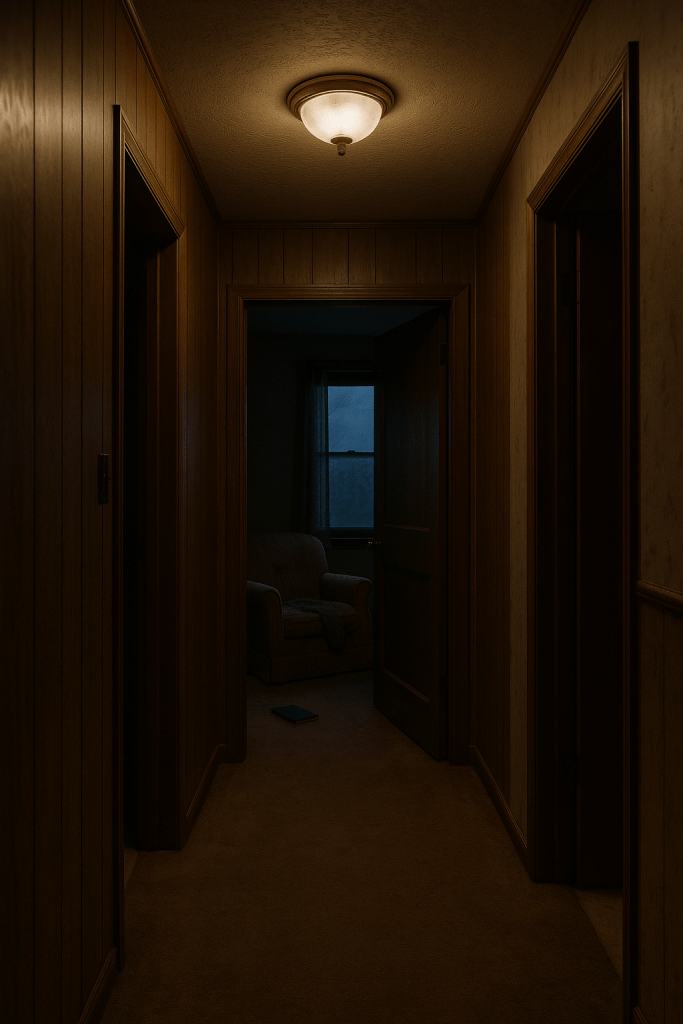
She kept journals next to her chair in the living room—the chair with black ashy divots burned into the corduroy where she dropped lit cigarettes while nodding off. The stuffing underneath had crisped into little scorched folds that snagged at your clothes if you made the mistake of sitting in the throne. She kept her devotionals there: half prayers to God, half curses about her first daughter. Me.
I would find the journals sometimes. I didn’t read them in full—the writing wasn’t coherent enough to reward curiosity—but the refrains lodged in me.
“I am powerless, God has so much power,” followed immediately by, “I hate Dave and Jennifer so much.”
That was the gist. Every page a looping thesis about how my father and I were demons in her life, conspirators keeping her from happiness. I was a child. My brain hadn’t finished knitting itself together. But in her cosmology, I was already an adversary.
My sister likes to say she sees ghosts. That my father and I carry the same dark ones. It’s a literary way of saying she’s scared of our anger without acknowledging that Mom manufactured the conditions for that anger and then blamed us for inheriting it. Our “demons” were drywall holes and patched-over doors—an overworked father teaching an insolent daughter how to repair the consequences of emotional weather systems created upstairs, where my mother washed down pain pills with Diet Coke and scripture.
My aunt is angry with me—she texted as much—but I don’t think she understands that the symbols in her life overlap with the ones that detonated mine. I cannot walk into another house humming with denial and letters written about me, metaphorical or otherwise. My uncle is deep into his withdrawal spiral; his body has curled around the narcotic like a question mark he refuses to answer. He’ll insist he “doesn’t get high,” which is a quaint moral stance—one of those phrases people cling to when the truth is too bright.
But you cannot shit a shitter.
Morphine rewired my entire life, even by proxy.
I don’t need another man writing an unloved version of me into his margins.
When I was young, I moved out because my father beat the shit out of me. I don’t need to retell the night; that scene has been excavated in other essays. What matters here is this: I never saw my siblings treated like that. And I think often about the moment I realized I had to leave. What would you do if you knew there were twenty notebooks in the next room filled with hatred written by the woman who was supposed to love you without condition?
My mother was a wretched person to me, and I feel oceans of guilt saying it.
I spent a decade in therapy making peace with her ghost.
I told my sister to stop talking badly about her.
I thought I was done with the whole mythology.
But now my sister stands across from me, calling my anger a demon, flattening me into the devil. And all I can think of is that childhood song I used to sing to her:
Shut the door, keep out the devil.
Shut the door, keep the devil in the night.
Somehow I’m the one in the cold now, shut out, pacing the border of someone else’s narrative.
I might use AI to smooth a paragraph or sharpen a metaphor, but no one else has my story. I would never consign another human to live this particular script. I didn’t stand a chance in my mother’s life because I was too much like my father, and while I can guess at the violence he may have perpetrated, I also know this: naming the truth is not abuse.
I couldn’t live down my relationship with Morphine Mommy; I doubt I’ll outlive Fent-Bent Uncle either.
If you made it this far, you can try to decipher what’s me and what’s machine, but understand the essential thing:
none of this is fiction.
The metaphors are real. The ghosts are real. The harm is real.
The story—God help us all—is real.
 the misfit west