December 9, 2008 sits in my body like a bruise that never finished blooming.
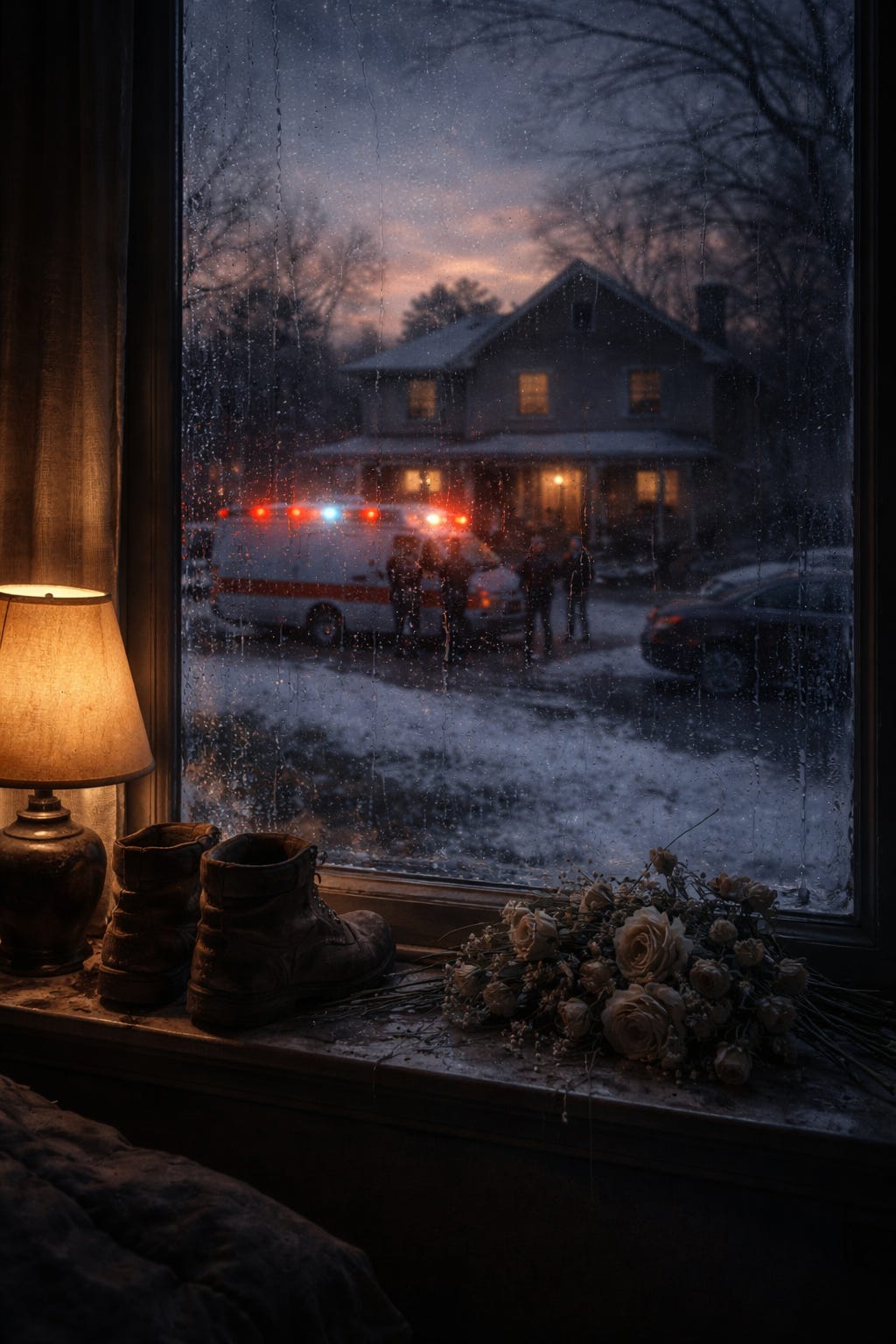
It was that hour after sunset when the sky goes the color of a dirty dish towel and the house smells like someone should be cooking, but no one is. Four o’clock. The clock still mattered then. Time still pretended to be orderly.
My father fell from the second story of my childhood home. The drop was short enough to seem survivable. The concrete below disagreed. He struck his head, hard enough that his body revolted—vomit on cold ground, breath hitching, the animal panic of a system that knows something is wrong but can’t yet name it.
Cold moved in faster than help. December doesn’t wait.
At the hospital, I held his hand. It was still warm. That detail matters to me. Warm meant possibility. Warm meant walkers, physical therapy, the clean ache of rehab rooms, the promise of small victories—standing, swallowing, smiling at the wrong joke. I cataloged hope like a professional.
Then a man in a white collar entered the waiting room.
He did not rush. He did not sit. His shoes were quiet on linoleum. That’s how I knew. The body understands before the mind signs off.
After that, time stopped pretending.
Seventeen years later—seventeen years, ten days, a handful of stray hours—I still wake up thinking about his family. His brothers and sisters. The people who knew him before I did, or claimed to.
I have almost no stories.
My mother erased them before she died—unfriended, unfollowed, cut loose like diseased branches. When she spoke of them, it was with the flat, venomous efficiency of someone who had already made up her mind. Two brothers. Two sisters. Shadows with names.
The stories that reached me anyway arrived sideways. A teenage sister handed alcohol by an uncle like it was a secret handshake. Conversations about sex that didn’t belong to him. An uncle who teased girls onto his bare lap, shirtless, joking, smiling. The kind of memory that doesn’t shout, just stains.
I want forgiveness to be simpler than this. I want it to be a decision, not a daily negotiation with my nervous system. I tell myself everyone carries shadows. I tell myself families are messy. I tell myself I am not the judge.
And still—every time I try to contort myself into something palatable, something worthy, I am punished for it.
The racist remarks left on my page didn’t start the rupture, but they named it. They crystallized a truth I’d been circling for years: some people cannot bear witness. They scroll past discomfort. They disappear you quietly. The way they disappeared my mother. My brother. My sister. My father.
I learned early to take the blame.
I was difficult. I was too much. I was an addict. These were convenient containers, tidy enough for other people’s relief. On paper, though, the math doesn’t work. I’ve done the same training, the same hours, the same work as peers charging two hundred and fifty dollars a session behind polished clinic walls. There’s an irony in how often I sit across from clients whose wounds rhyme with mine.
Some days I want that to mean something noble. Some days I am just tired.
I listen. I bear witness. I help them stitch meaning out of rubble. And sometimes, quietly, privately, I wonder how I’m supposed to survive my own isolation. What does this kind of solitude do to a body over decades? What does it calcify?
The night I blocked my aunt, I did it slowly. Manually. Name by name. Even the uncle who once listened when things were darkest. On his page was a photo from my father’s funeral. My father—quiet, unassuming, deeply loved.
None of us were in the picture.
Not the people who lived with him. Prayed with him. Watched him read bedtime stories until his voice softened and the room went syrup-thick with safety. The funeral had blurred by then anyway. My workplace hosted a luncheon—white tablecloths, careful smiles. His family arrived dressed up, said almost nothing, and left promptly for their lives.
Grief, apparently, had a schedule.
My father mattered in a way that still feels untranslatable. I was a daddy’s girl without theatrics. We didn’t need constant conversation. I knew the smell of him. I knew the rough geography of his hands when we prayed together. His startling blue eyes. His soft hair, which he let me mess up before opening a book and launching into our beds like it was a holy calling.
The Boxcar Children became my cousins. Hobbits taught me how endurance works. Adventure wasn’t abstract—it was training.
I removed my aunt from the mailing list. Cut off her access to my life. The final offense was small and stupid: I named something true—that she and my other aunt orbit men like moons, regardless of the gravity involved. Since they aren’t reading, I’ll say it plainly: the men they’ve chosen are repugnant. Putrid. Whatever kept my father away from that family for years at a time lives in me now too.
They speak of my mother with a casual disrespect that still rearranges my bones.
I love my parents. I carry them everywhere. I wish—still, embarrassingly—that my family cared enough to see me clearly, or at all.
December 9 keeps ticking forward. The bruise never heals. I don’t need it to. I just need it to be named.
And this—this is me naming it
.
 the misfit west
Leave a comment