Category: Uncategorized

  • credentialing catharsis

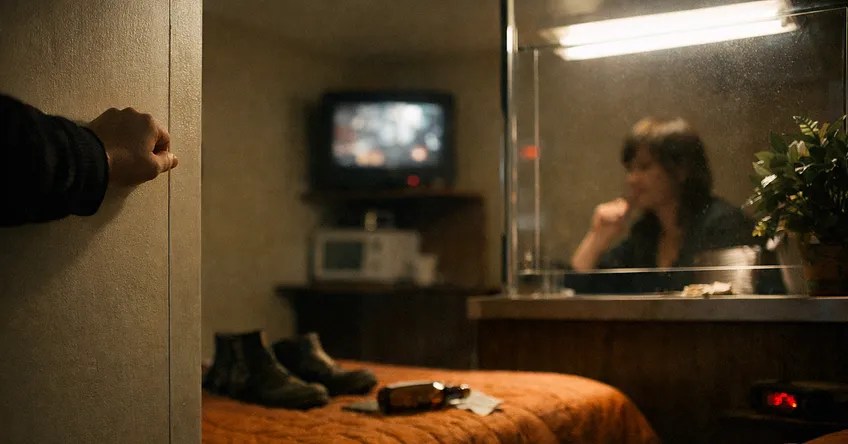
    At 10:59, the door takes two knuckles—not a knock, not a greeting. A reminder with bones. In the hallway, a television laughs at nothing. A child runs the length of the carpet and back, as if the building contains a track. The blanket presses its orange geometry into skin—little squares, shipping stamps, proof of transit.

    In the lobby, a plastic fern shines with waxed dust. Behind Plexiglas, the clerk worries a hangnail until it bleeds. Her nail curves, hooks, releases. She sings the line like policy recited as prayer: check-out at eleven.

    Everything here knows its job.

    A cooking show murmurs salvation made of butter. The refrigerator coughs, rests, coughs again. Boots dangle off the bed. A bottle tips, then steadies. No sex—never a trade, never a price. Men provide rides and pizza and a body between danger and the drop, and then they leave cologne ghosts behind.

    The phone lights my face like a campfire. It never warms me.

    I send the link anyway.

    It’s short. Five minutes. A whisper. A prayer. The kind of reading that fits between red lights and microwaves. The screen delivers the same quiet: delivered, delivered, delivered.

    When the response arrives, it arrives prepackaged.

    That’s really dark.

    Not a line. Not a question. Not a place where the sentence caught. Just a classification, like weather. Like the work has failed at being pleasing.

    Dark, as in: unruly.

    Dark, as in: doesn’t resolve.

    Dark, as in: you’ve brought something here that won’t behave.

    On television, suffering behaves. A drunk father. A capable daughter. Chaos arranged into arcs that end on schedule. People binge it and call it gritty. They feel sophisticated for tolerating the mess because the mess stays behind glass.

    In real rooms, the eyes slide away.

    Not dramatically. Just enough. A glance toward the door. A phone check. A sudden interest in menus, grout, the exit points of a table. The same movements appear when a personal essay lands in an inbox: pause, deferral, the decision to let it sink.

    Silence becomes a response style.

    Psychologists have a name for the way relationships strengthen when good news is met with engaged attention—questions, interest, presence. They call it capitalization. The opposite response—flatness, indifference—doesn’t merely fail to help. It erodes.

    Art is a capitalization attempt with teeth.

    It says: this is what I see. This is what happened. This is what I made of it. It asks for witness, not applause. And witness is not neutral. Witness confers legitimacy. Witness redistributes authority.

    So most people opt out.

    They praise from a distance. They say she’s such a good writer the way they say that town has good food. Portable. Untested. They keep the relationship to the maker while refusing the making. The hierarchy holds.

    This pattern repeats across domains.

    Someone insists they don’t feel anything after stimulants at four in the morning, jaw working, stories multiplying. They lecture about addiction as weakness, baffled that nicotine could touch them. Immunity is their favorite credential.

    A friend says of morphine, with pride disguised as concern: he doesn’t get high. he hates that. As if an unverifiable interior state elevates him. As if wanting relief is shameful but needing it—properly framed—is noble.

    Denial performs status.

    The same economy governs art. Some damage is acceptable if it is credentialed—screened, aestheticized, contained. Some testimony is welcome if it arrives with institutional blessing. The rest is called dark and quietly refused.

    Families are especially good at this. Familiarity fossilizes the story. Reading the work would require revision—of memory, of hierarchy, of who gets to name what happened. Avoidance preserves the file.

    So the work remains unopened. The writer remains discussable.

    I notice how often recognition arrives sideways.

    A stranger reads. A professor says yes. A workshop invites. A weak tie becomes a bridge. The people closest—the ones who “matter most”—can’t give five minutes to the sentences that hold my life.

    This isn’t romance or justice. It’s structure.

    Sociologists describe how weak ties transmit new information better than strong ones because they connect outside closed loops. Close circles echo. Distance carries signal.

    The fantasy says family is where the deepest holding lives. The data—and the culture of estrangement it documents—say something colder: intimacy often invests most heavily in denial. The person who names reality becomes the problem by definition.

    In the motel parking lot, I walk to the superstore where charity and bargains share an aisle. A man asks for a dollar for fruit. I bring him an apple. Another man’s look tells me the corner has rules I don’t understand. The wind folds my cardboard sign like a bad fortune.

    Invisibility becomes a skill.

    Invisibility makes the world easier—until the writer tries to be seen.

    That moment looks small: a texted link; a subject line; a would you read this? Inside, the body braces for the old maneuver: deny, erase, feign confusion.

    Rejection would at least touch the work. The softer violence is the non-event. No click. No trace that the words entered another mind.

    A book can handle bad reviews. A book can handle conflict. A book can handle being called too much.

    A book cannot argue with being ignored.

    That’s why the clerk’s hymn lands so cleanly. Check-out at eleven. An institutional version of the same message: time’s up; move along; no one holds you here.

    And still, some doors open.

    Not because the work becomes gentler. Not because it performs gratitude. Because certain rooms are built to tolerate reality, not replicas. They are fewer. They are quieter. They require actual looking.

    This doesn’t guarantee recognition. It doesn’t promise relief.

    It clarifies the conditions.

    At 10:59, the door takes two knuckles. The fern shines. The nail hooks, releases. The phone lights my face like a campfire.

    I send the link anyway—not as a plea, not as a performance, but as record. As proof of passage. As breath.

    At eleven, I walk out.

  • hookups

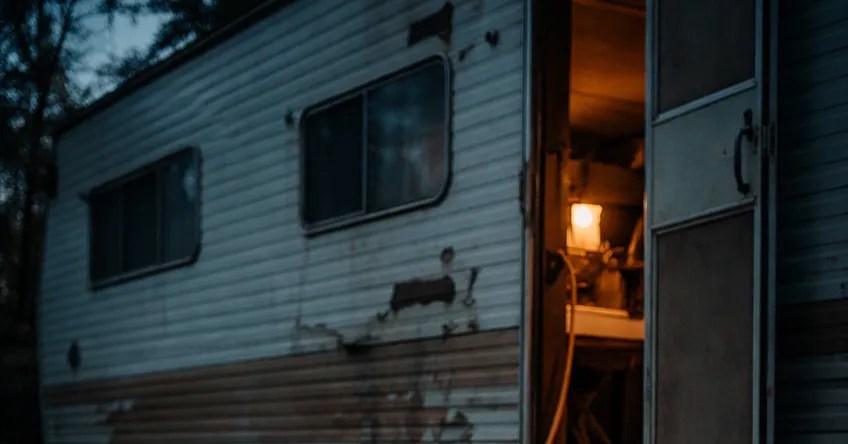
    The camper sat where things went to disappear. Not hidden—just off to the side, behind cottonwoods that never thickened. Wind moved through them like it had permission.

    It had once been a camper. That was the rumor. He’d stripped it down and rebuilt it without finishing anything. Walls opened into nothing. Wires crossed where shelves used to be. Plywood met plywood and didn’t line up.

    Nothing had a final form.

    A rearview mirror was screwed into the bathroom wall. Crooked. Beneath it, a hose hung loose, looping into a plastic bin. The bin held water when it felt like it. The floor dipped there. I learned where not to stand.

    There were hookups—electric, water—but they felt provisional. Like a favor that could be revoked mid-sentence. I kept waiting for a sound that would mean the whole place had decided to quit pretending.

    We were cleaning.

    Cleaning meant shifting objects so the floor could be seen briefly. Tools without pairs. Screws loose in mugs. Ash in places ash didn’t belong. Old food bags folded small, like they were trying to behave.

    I wiped the counters. The surface was already ruined, but I wiped anyway. Habit. A way to keep my hands occupied.

    The air carried a sharp, sour heat. Chemical. Burnt. The microwave was plugged into an extension cord that ran under the door. I noticed that and filed it away. I noticed a lot of things and didn’t say them.

    I had moved in because there was nowhere else.

    That wasn’t a confession. It was a fact, like the wiring.

    I slept dressed. Shoes stayed by the door. My bag stayed zipped. I learned how to move through the space without brushing against too much. When I stood still, the place felt unstable—not collapsing, just waiting.

    He moved easily inside it. Like it made sense. Like this was how things were supposed to be arranged.

    The microwave light clicked on.

    My phone turned slowly behind the glass. Once. Again.

    The sound was ordinary. That was the problem. The low hum, the small motor doing its job. The room didn’t react. Nothing tipped. Nothing cracked.

    Outside, a truck passed. Gravel shifted. Then it was gone.

    The smell changed quickly—hot plastic, something metallic, bitter at the back of the throat. The microwave kept going.

    He stood close. Close enough that I could smell old coffee on his breath. Close enough that I didn’t step back.

    I watched the phone spin. I watched the time pass without numbers.

    When it stopped, the room stayed the same. Counters. Floor. Mirror. Hose.

    Later—much later—the smells started showing up in other places. Bleach. Ozone. Warm dust. Appliances made me pause. The sound of fans stayed too long in my ears.

    I cleaned more carefully after that. Slower. As if moving wrong might wake something.

    Time passed the way it does when nothing interrupts it. Days stacked. Nights folded in on themselves. I learned which boards flexed and which held. I learned which silences were normal.

    When I left, I didn’t take much. The phone was already gone.

    Sometimes now, a microwave hum will catch me off guard. Not fear—just attention. The way the body keeps a list it never shows you.

    The West likes things that look unfinished. It mistakes exposure for toughness. It calls improvisation resilience.

    The camper is still there. I drive past it sometimes. The cottonwoods haven’t filled in.

    I don’t stop.


    Morning came without fixing anything.

    I drove into town with the windows down even though it was cold. My phone was useless now—hot, warped, wrong—but I carried it anyway. Habit. Proof. I parked at Jack’s Liquor because it was open and because I didn’t know where else to go.

    Inside, the floor was sticky in the way liquor store floors are. Bottles stacked too high. Fluorescent light that made everyone look unfinished. I asked about a phone. The man behind the counter shrugged. Not unkind. Not helpful.

    Outside, the wind pushed at my back like it wanted me gone too.

    When I drove back, my things were already in the yard.

    Clothes. A bag split open. Papers lifting and dropping like they couldn’t decide what mattered. Nothing broken. Nothing arranged. Just displaced.

    Something in me went loud.

    I don’t remember deciding to scream. It was already happening by the time I crossed the line where the yard turned into dirt. My throat opened and didn’t close again. Sound without shape. Sound that didn’t care who heard it.

    The motorcycle was leaned on its kickstand near the camper.

    Black. Heavy. Too confident in itself.

    I didn’t think about it. I put my shoulder into the metal and used everything I had—legs, back, the stored-up effort of not asking for help, of sleeping dressed, of waiting for things to fail. It tipped slower than I wanted, then faster, then it was down.

    The sound it made was final.

    I went inside still screaming.

    The back area where the bed was cut off from the rest of the space by a half-wall that didn’t reach the ceiling. Light pooled there differently. Dimmer. Closer.

    That’s where he was.

    He reached down and brought up a sawed-off shotgun like it had been waiting. Short. Unreasonable. Pointed directly at my face.

    I didn’t stop.

    I didn’t flinch. I didn’t step back.

    The screaming narrowed into words I didn’t recognize as mine until they were already gone.

    The gun stayed where it was. His hands moved, then didn’t. The room held its breath. I don’t remember the sound of it leaving, only the door.

    After, the space felt emptied out. Not safe. Just abandoned.

    I took the change from a cup by the bed. Quarters, nickels, whatever fit in my pocket. I found a small bottle of whiskey tangled in the sheets. I took that too.

    Outside, the motorcycle was still on its side. My clothes were still in the yard. The wind was still doing its job.

    I didn’t stay to clean.

    ____________________________________________

    ⚠️ Reader Support & Content Notice

    This essay includes reflections on experiences of coercive control, isolation, and intimate partner harm that some readers may find emotionally intense, distressing, or triggering. If you are currently in a situation where you feel unsafe, coerced, or under threat — or if this writing brings up past trauma — know this without sugar-coating: your safety matters more than anyone’s story.

    You don’t have to endure harm alone.

    If you are in immediate danger:

    📞 Call 911 (U.S.) right now — your life and wellbeing are priority one.

    National and Confidential Support (U.S.):

    📞 The National Domestic Violence Hotline: 1-800-799-7233 or Text START to 88788 — 24/7 confidential support, safety planning, and referrals to shelters and advocates near you.

    💬 RAINN National Sexual Assault Hotline: 800-656-HOPE (4673) or online chat/text options — trained listeners available 24/7.

    Find Local Help:

    🏠 DomesticShelters.org — searchable directory of shelters and support programs across the U.S.

    Emotional and Mental Health Support:

    📘 To Write Love On Her Arms (TWLOHA) — hope and connection for people struggling with depression, trauma, or crisis.

    💛 Reach out to a trusted therapist, counselor, or mental health provider who uses trauma-informed care principles, which recognize how power, fear, and control shape survival responses.

    If you’re supporting someone else:

    Listen without judgment, believe what they tell you, and help them connect to professional resources at their pace.

    You deserve support and safety. If this piece resonates, take a breath — and take the next step toward care that feels right for you.