The gloves smell like old water.
I don’t notice it right away. I’m already up to my elbows in the sink, hot water running hard enough to turn the room to fog, a narrow winter sun flattening itself against the kitchen window. The gloves are a cloudy blue, rubber gone soft and thin at the fingertips. I bought them after the skin on my hands split open from the dry air and the heat and the soap. Little red mouths along my knuckles. So now I slide into these damp sleeves that hold the memory of every other sink of dishes I’ve washed in this house. The inside smell is stale and sour and faintly sweet, like a mop bucket forgotten in the corner of a church basement.
I turn the plate under the stream until the last streak of oil dissolves. The sound of the water swallows everything—the wind outside, the heater kicking on, the small elastic pop of my dog’s joints as she shifts on her bed behind me.
This is usually when it starts.
I look at the plate, then at the rest of the sink: the chipped mug, the spoon with yogurt clinging to the bowl, the glass that held last night’s Advil. Then I look past the dishes to the counter, to the mail stacked in its half-hearted tower, to the notebook splayed open with a pen bleeding through the page, to the bowl of shriveled limes I keep forgetting to throw out. My eyes keep moving, hooking on each object: the bookshelf, the crooked lamp, the blanket slumped over the arm of the chair, the dog’s toys, the stack of folders with my uncle’s name printed in careful black letters at the top.
I picture all of it without me.
Will it be easy to get rid of? That’s the question that runs underneath the hot water, under the smell of rubber and detergent. Has it always been this easy to clear me out? A few boxes. A phone call. An estate sale on a Saturday.
When my uncle died, it took less time than I expected. I kept waiting for a secret to emerge—some hidden compartment, a false bottom, a letter taped under a drawer. He had spent his whole life guarding things, smoothing the surface, protecting the story. When I walked through his house after they carried him out, the carpet smelled like dust and old coffee and a man who had tried very hard not to leave a mess. The blue-green of it was already fading in the high-traffic places. The trash cans were mostly empty. The bathroom cabinet held three half-used bottles of aftershave and the razor he’d used that morning. His closet looked like a store display: shirts organized, shoes paired by the door. I remember standing there, thinking: That’s all. That’s really it.
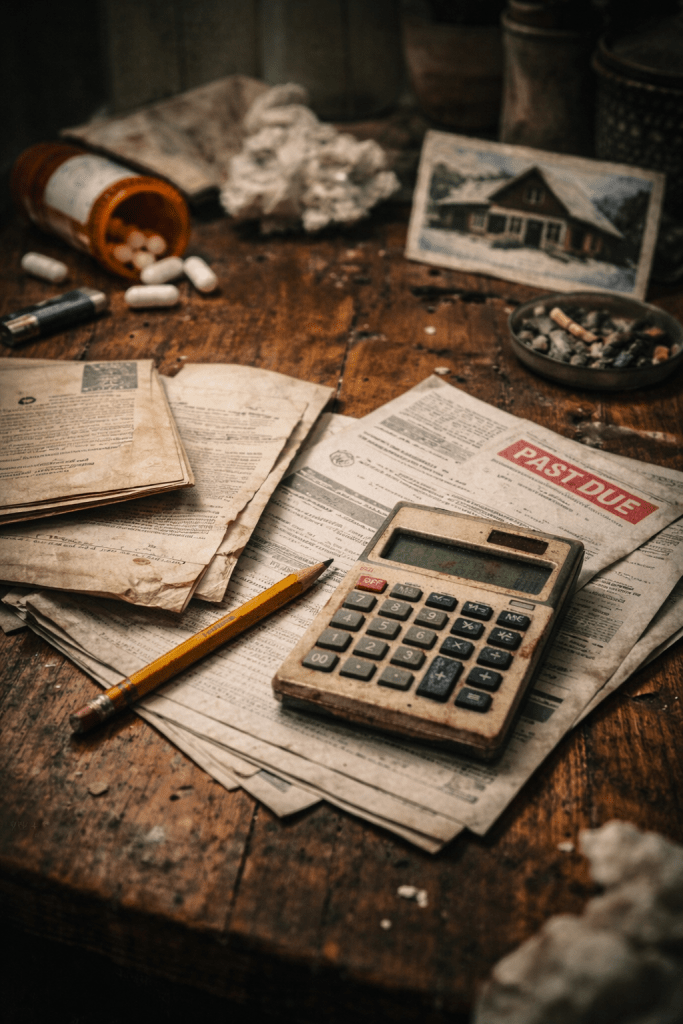
And then my sister took charge and whatever he’d been trying to keep contained blew wide open. Bank accounts, loans, mortgages he’d kept current by some quiet miracle. The money he’d stacked with the same care he used to fold his shirts, now shuffling out of the accounts like it had been waiting for her hand. It wasn’t the spending itself that made me dizzy—it was the echo of my mother in it, the old QVC boxes piling up on the porch, the way she would buy and buy and then sit us down and lecture us about how we never had anything. We were always broke, she assured us, as a new package arrived. It is a particular form of madness, being told you are poor by someone who will not stop consuming.
I rinse the plate until my fingers go numb inside the gloves. Outside, a gust of wind slaps the siding, a hollow sound, like a hand hitting a bare back.
I think about death most days. It’s not dramatic; it’s logistical. Each cough, for example. I feel the rasp in my throat and immediately picture a shadow on an X-ray, the white smear of something that will not respond to treatment. On days when my lungs behave, my brain rewrites the script: early-onset dementia, little holes in the gray matter that will quietly empty me out until nothing is left but reflex. I misplace a word and feel the edge of it—the possibility that this is the beginning of the end and I will never again trust my own sentences.
They say there’s a name for this—the way the mind circles death after enough blows, rehearsing it, tracing the routes by which you might leave. Someone wrote that people who have watched a parent die, or disappear, often live with death seated just offstage. Not a fear, exactly. An assumption. A constant readiness.
I call mine the death feelings, but lately it feels more honest to call it being awake.
I scrub the fork, working the sponge between the tines. The motion is small but aggressive. My hands ache inside the gloves. The eczema—or whatever it is—has left my skin thin and itchy. The gloves let me turn the water up hotter than is strictly necessary. I like the burn. I like the way it makes my fingers feel separate from the rest of my body, like I could peel them off and set them on the counter when they get too loud.
My mother used to stand at the sink, too. I can see her there if I close my eyes: cigarette balanced in the corner of her mouth, ash growing too long over the basin, late-night infomercials chattering from the living room. The counter behind her was often lined with cardboard boxes—beauty kits, vacuum-sealed containers, a sequined top she’d ordered at three in the morning. She would tear into them with an eagerness that embarrassed me, then stack the contents neatly while complaining about how we never had anything. We were always broke, she reminded us, as if the evidence on the counter were proof of our ingratitude.
She hated being seen, my mother. She hated her own reflection, the way the overhead light made her skin look sallow. She hated her body, her marriage, the town, herself. I know these things because she made sure I knew. I also know what it looks like when someone cannot metabolize their suffering, when it curdles and pours out sideways onto the nearest person. I know how it feels to have a parent who would rather die than admit she was hurting.
I turn off the water. The house exhales with me.
The quiet is a physical thing. It lays across my shoulders, settles over the dog, seeps into the cracks along the windowsill. There is no radio. No one calling to ask how I’m holding up. The phone, when it rings, usually brings obligation, not comfort. I have become careful about what I share with the people who are left. I have learned that certain sentences trigger a kind of arms race of suffering: I say, “I’m having a hard time,” and someone responds, “You think you have it bad?” I say, “I’m scared,” and someone answers with a catalogue of their own emergencies. By the end of the call, I’m apologizing for opening my mouth.
I read once that there’s a term for this, too—the way some people respond to another’s pain by immediately asserting their own. It’s not evil. It’s a learned survival strategy. A way of saying, “Don’t forget me. I hurt, too.” In families like mine, where violence and scarcity were the wallpaper, it became a reflex. Whoever bled loudest got the bandages.
I never did learn to bleed loudly enough.
Instead, I wrote.
At first, I did what I was supposed to: framed my pain with quotes from other, more acceptable women. I lined the pages with Toni and Maya and Margaret and Annie, letting their words rinse mine until the whole thing felt more palatable. I wanted their sentences to bless my own, to make them less embarrassing, less ugly. I wanted to be the kind of person whose suffering made her wise.
But the more I wrote, the less that approach worked. The quotations began to feel like apologies. Like I was saying, “Don’t worry, I know my life is too much; here’s someone more important to make it go down easier.” I began to resent the way my paragraphs yearned toward a lesson. It felt like lying. There is no moral to having your mother’s voice in your head telling you you’re ungrateful from beyond the grave. There is no clean takeaway to realizing your uncle—the one person who loved you without trying to reshape you—saved every penny only for it to be siphoned away into someone else’s account.
He used to say my stories were dark. “So dark,” he’d say, half admiring, half uneasy, his mouth tugging to the side in that way it did when he was trying to be gentle. I didn’t know how to explain that darkness was the only honest tone I had. That I wasn’t writing to shock anyone. I was writing to keep myself from disappearing. There are people whose families frame their work on the walls, put clippings on the fridge. Mine reads and looks away, then tells me I have the wrong idea about what happened.
I pull the plug. The water circles the drain, taking foam and crumbs and the last heat with it. The gloves drip on the edge of the sink, little pale hands empty of bones.
This is where the death feelings settle, once the task is done: in the space between the routine and the void. I picture my belongings being sorted: notebooks opened then closed, dog toys tossed into a bag, the lamp unplugged, the books divided into keep and donate. My writing reduced to a stack of paper someone will skim at most. I picture the ease with which someone could erase me—how quickly the narrative could tighten around the absence.
Nothing resolves. No lesson arrives. The death feelings settle back into their usual place behind my ribs, an extra organ, humming.
 the misfit west